
How to Choose the Right Micromanipulator for Pharmaceutical & Cosmetic Sample Collection
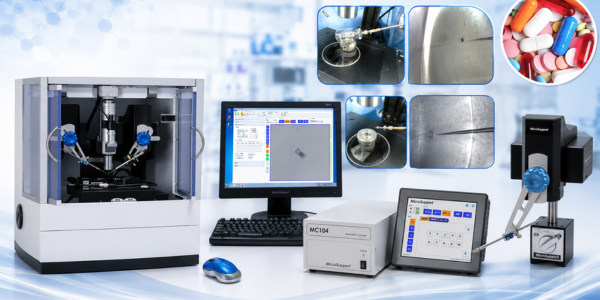
Foreign particle contamination is one of the most common, and most disruptive, quality issues facing pharmaceutical and cosmetic manufacturers. A fiber in a cream, a floating particulate in a liquid formulation, or a foreign fragment in a vial can trigger a full QC investigation, and getting to a confident root cause depends on one critical step: isolating that single contaminant intact, without damaging it, so it can be properly identified.
That’s where a micromanipulator comes in. But not all micromanipulator setups are the same, and choosing the right configuration for your lab depends on your sample types, your existing microscopy equipment, and the downstream analysis you’re preparing for. This guide walks through what to consider, using MicroSupport’s micromanipulator accessory line, designed specifically for pharmaceutical and cosmetic sample collection, as a reference point throughout.
What Does a Micromanipulator Do in Pharma & Cosmetic QC?
A micromanipulator is a precision instrument that allows an operator to interact with microscopic samples under magnification, picking up, moving, or extracting particles far too small to handle with standard lab tools. In pharmaceutical and cosmetic quality control, this typically means isolating a contaminant (a fiber, particle, or fragment) from a product sample so it can be transferred to a slide or substrate for chemical identification.
The core value is precision without destruction: the contaminant needs to come out of the cream, solution, or vial intact, so that the identification technique used afterward, such as Raman microscopy, returns an accurate result.
Microscope-Integrated vs. Independent Micromanipulator Systems
MicroSupport offers two general system approaches, and choosing between them largely comes down to your existing lab setup:
- Microscope-integrated systems, such as the Axis Pro benchtop micromanipulator, are dedicated units that combine a microscope and micromanipulator into a single sampling platform, purpose-built for this kind of precision work.
- Independent micromanipulator systems, such as the QuickPro, are designed to install onto a microscope you already own, controlled via touchscreen or mouse. This is a strong option for labs that already have a suitable microscope and want to add isolation capability without replacing existing equipment.
You can browse the full range of available configurations on Barnett’s Micromanipulators product page.
If your lab already has a high-quality stereomicroscope in daily use, an independent system may be the more cost-effective path. If you’re building out a dedicated sampling station, an integrated system offers a more streamlined, purpose-built workflow.
Manual, Motorized, or All in One: Which Configuration Fits Your Lab?
MicroSupport’s product line spans manual, motorized, and all-in-one configurations, each suited to different priorities:
- Manual systems offer a lower-cost entry point for labs with occasional sampling needs and an experienced operator.
- Motorized systems provide finer, more repeatable control, controlled through software via mouse or touchscreen, which is valuable for labs running frequent contamination investigations or requiring documented, repeatable procedures.
- All in one systems combine the microscope, stage, and manipulator arms into a single integrated platform for labs that want a dedicated, ready to use sampling station.
The right choice depends on sampling frequency, required precision, and whether your lab needs to standardize the procedure across multiple operators.
Matching Micro-Tools to Your Sample Type
Different contaminant types call for different tool heads, and this is one of the most practical considerations when configuring a system:
- Micro-tweezers are effective for extracting fibrous contaminants from solid or semi-solid matrices, such as fibers embedded in a cream.
- Micro-injectors are better suited to floating or suspended contaminants in liquid formulations, allowing the operator to aspirate a small volume containing the target particle.
- Tungsten probes and tungsten carbide tools support a wider range of general purpose tasks, including poking, scraping, cutting, and picking up particles from solids, powders, and adhesive layers.
A system that supports interchangeable tool heads gives your lab the flexibility to handle multiple contaminant types without needing separate dedicated equipment for each.
Preparing Isolated Particles for Raman Analysis
Choosing the right micromanipulator setup isn’t only about the isolation step. It also depends on what analysis comes next. For chemical identification, isolated particles are commonly analyzed using Raman microscopy, which requires the particle to be cleanly transferred onto a compatible substrate without contamination or damage to return an accurate result.
This is why the isolation method matters as much as the identification technique itself: an intact, uncontaminated particle, properly mounted for analysis, is the foundation for a reliable result. When evaluating a micromanipulator system, it’s worth confirming that the tool heads and accessories available are compatible with your lab’s downstream analysis workflow.
Optional Features Worth Considering: X-Y-Z Stage and Transfer Accuracy
For labs that need to transfer isolated micro-samples precisely onto an analysis substrate, an optional X-Y-Z stage can add an extra layer of positioning accuracy. This is particularly useful for labs running high volumes of contamination investigations, where consistent, repeatable sample transfer reduces the risk of particle loss or misplacement between isolation and analysis.
Real-World Example: Isolating Contaminants from Creams and Solutions
Two practical examples illustrate how this works in practice:
Fibrous contaminants in a medical cream: The cream sample is applied directly onto a glass slide for observation under the microscope, and the fiber is then collected using micro-tweezers, extracted cleanly from the cream matrix without disturbing the surrounding material.
Floating contaminants in a solution: For liquid formulations, a micro-injector is used to aspirate the liquid containing the suspected contaminant. The aspirated sample is transferred onto a glass slide, washed, and prepared for further analysis, recovering the particle without altering its structure.
Both examples show the same underlying principle: matching the right tool to the right sample type results in a clean, intact isolation, the foundation for an accurate root-cause identification. For more applied case studies like these, see Barnett’s Steve’s Solutions series.
Choosing the Right Setup for Your Lab
There’s no single “right” micromanipulator. The best configuration depends on your sample types, your existing microscopy equipment, your sampling volume, and the downstream analysis techniques your lab relies on. Barnett Technical Services can help walk through these considerations and match the right system and accessories to your lab’s specific needs.
Download the full MicroSupport Pharmaceutical & Cosmetic Applications brochure to see additional real-world examples, or contact Barnett Technical Services to discuss which configuration fits your lab.