
Precision Collection of Microscopic Foreign Substances from Deep, Narrow Holes Using Bent Tungsten Probes
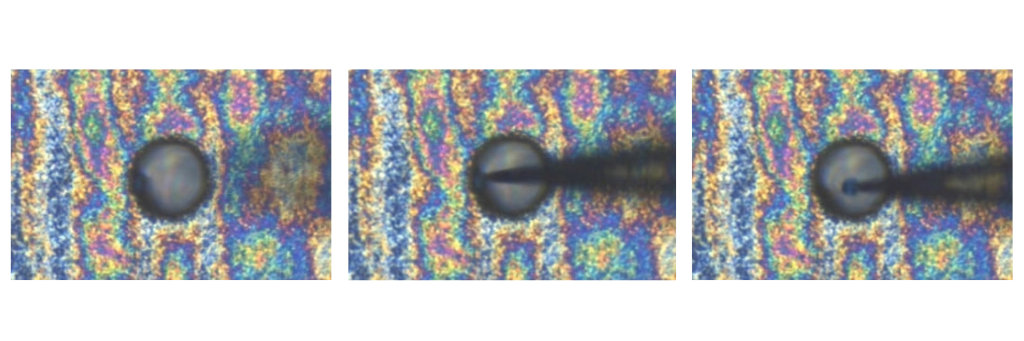
Collecting or removing a microscopic foreign substance from deep inside a narrow hole is one of the more difficult problems in microsampling. The target may be only a few micrometers across, sitting inside an opening just tens of micrometers wide and a straight probe approaching head-on often cannot get there without striking the walls of the hole first. One practical way around this is to change the probe’s approach geometry rather than its size. Bending a tungsten probe to a controlled angle gives it a path into spaces a straight probe cannot reach, and MicroSupport’s Probe Bender is the tool built specifically to create that bend.
Why Probe Geometry Matters in Microscopic Sampling
It’s a common assumption that reaching a microscopic target is mainly a matter of using a finer tip. In practice, the shape and orientation of the probe matter just as much as its size. A probe’s geometry determines whether it can physically reach a recessed target at all a bent probe can offer an approach angle that a straight one simply doesn’t have. The bend changes how the probe approaches the target; it does not change how large or small the target itself is. At the scale these operations happen often measured in single-digit micrometers controlled, deliberate probe positioning is what makes the difference between a successful collection and a failed attempt.
The Challenge of Foreign Substance Removal from Narrow Holes
Foreign substances lodged inside small holes or recessed structures present a tight working environment. There’s little clearance around the target, and a straight probe moving in on the wrong line risks contacting the surrounding surfaces before it ever reaches the particle. Any unintended contact can disturb the target, damage the surrounding structure, or derail the sampling attempt. This is why controlled approach paths and precise probe movement matter more here than in open, easily accessible sampling conditions.
Creating a Controlled Bent Tungsten Probe with a Probe Bender
MicroSupport’s Probe Bender (PB-1) is an accessory purpose-built to bend compatible tungsten probes to a specified angle. It accepts MicroSupport tungsten probes measuring 40 mm in length with a 0.6 mm outside diameter, and bends them to either 15° or 30°, with the angle set by swapping in the appropriate block or shim. The bend position can be set at approximately 3 mm or 5 mm back from the probe tip. The unit can bend up to two compatible tungsten probes at the same time, and the process itself is straightforward the probe is placed in the holder, the guide plate is set, and the cover is closed to form the bend.
How a Bent Probe Improves Access to Recessed Targets
Once bent, the probe tip can approach a recessed target along a line that a straight probe can’t take. Rather than being blocked by the walls of a narrow hole, the tip can be guided in to follow the available space inside the opening. The right bend geometry gives the probe enough clearance to reach the target while reducing the risk of unwanted contact with the surrounding structure. How well this works in any specific case still depends on a combination of factors the geometry of the hole, exactly where the target sits, which probe is used, and how precisely it’s positioned.
Application Example: Removing a Microscopic Foreign Substance from an Inkjet Printer Nozzle
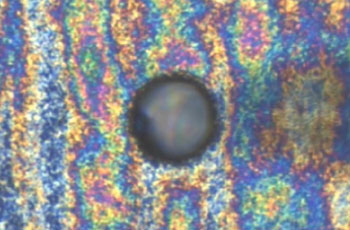
MicroSupport has documented this method applied to a real case: removing a foreign substance a few micrometers in size from inside an inkjet printer nozzle measuring only tens of micrometers across. The general workflow follows these steps:
- Locate the foreign substance under suitable magnification.
- Select an appropriate tungsten probe.
- Prepare the probe using the Probe Bender.
- Mount and position the probe for controlled access.
- Approach the foreign substance through the narrow opening.
- Collect or remove the targeted substance.
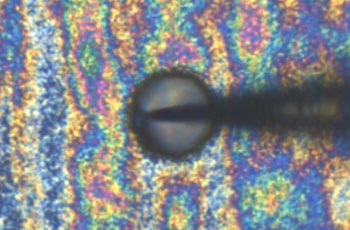
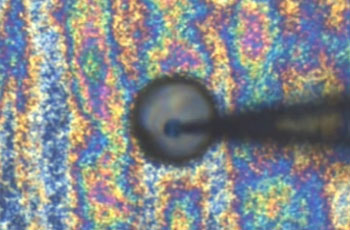
This example demonstrates what the method achieved in one specific nozzle and particle not a guarantee that the same outcome applies to every nozzle or every type of foreign substance.
Role of Precision Micromanipulation
Positioning a bent probe near a microscopic target requires controlled, fine-scale movement the kind a steady hand alone generally can’t provide at this resolution. A micromanipulation system supplies that controlled positioning, guiding the probe into place with precision. Its worth being clear about the division of roles here: the bent probe provides the access geometry, while the micromanipulator provides the controlled positioning and movement. The Probe Bender itself does not perform the sampling operation it only shapes the tool used to do it.
Combining the Probe Bender with AxisPro
The Probe Bender and MicroSupport’ s AxisPro micromanipulation system are designed to complement one another rather than function as substitutes for each other. The Probe Bender creates the probe geometry needed to reach a recessed target; the AxisPro then provides the controlled micromanipulation and positioning required to use that geometry effectively. Together, this pairing can help address sampling locations that are difficult or impossible to reach with a conventional straight probe and MicroSupport specifically identifies this combination as the intended setup for these harder-to-reach sampling cases.
Selecting the Appropriate Tungsten Probe
Choosing the right probe for a given job involves more than picking a tip diameter. Relevant factors include:
- Target size
- Hole or opening dimensions
- Target location
- Required sampling action
- Available working space
- Required probe access angle
Matching the probe’s geometry including, where needed, its bend angle and bend position to these specific conditions is what makes the difference in whether a sampling attempt succeeds. Fine tungsten probes can support a range of microscopic sampling and manipulation tasks, but the right configuration always depends on the application at hand.
Potential Applications
Controlled access to microscopic or recessed targets is relevant to situations such as:
- Inkjet nozzle inspection and maintenance
- Microscopic foreign-substance sampling
- Contamination investigation
- Precision particle collection
- Failure analysis
- Microscopic component inspection
- Materials and surface analysis
These reflect areas where the same access challenge tends to appear, rather than a confirmed list of validated applications actual fit should be evaluated against the specific application and relevant product documentation.
Best Practices for Bent Probe Sampling
- Inspect and identify the target before moving the probe.
- Select the probe and bend geometry to match the available working area.
- Use appropriate magnification for positioning.
- Ensure the probe is mounted securely.
- Approach the target gradually, under controlled movement.
- Avoid unnecessary contact with surrounding structures.
- Account for contamination control when collecting material intended for further analysis.
- Confirm the bent probe geometry provides sufficient clearance before attempting collection.
Key Benefits
- Improved access to recessed microscopic targets
- Controlled probe approach geometry
- More flexible probe positioning
- Support for targeted foreign-substance collection or removal
- Compatibility with precision micromanipulation workflows
- Ability to configure the probe for specific access requirements
Reaching a microscopic foreign substance deep inside a narrow, recessed hole is primarily a geometry problem not simply a matter of probe size. Bending a tungsten probe to a controlled angle opens up approach paths a straight probe cannot take, and the Probe Bender is the tool designed to create that geometry precisely and repeatably. Paired with the controlled positioning of a micromanipulation system like the AxisPro, this combination gives technicians a practical path to targets that would otherwise be effectively out of reach as shown in the documented case of clearing a foreign particle from an inkjet nozzle.
For precision microscopic sampling and foreign-substance removal applications, contact Barnett Technical Services to learn more about MicroSupport tungsten probes, Probe Bender accessories, and precision micromanipulation solutions.
Learn More:
MicroSupport Micromanipulators Tool Manipulation Accessories