
Thermal Conductivity vs. Thermal Diffusivity vs. Specific Heat Capacity: Understanding the Differences
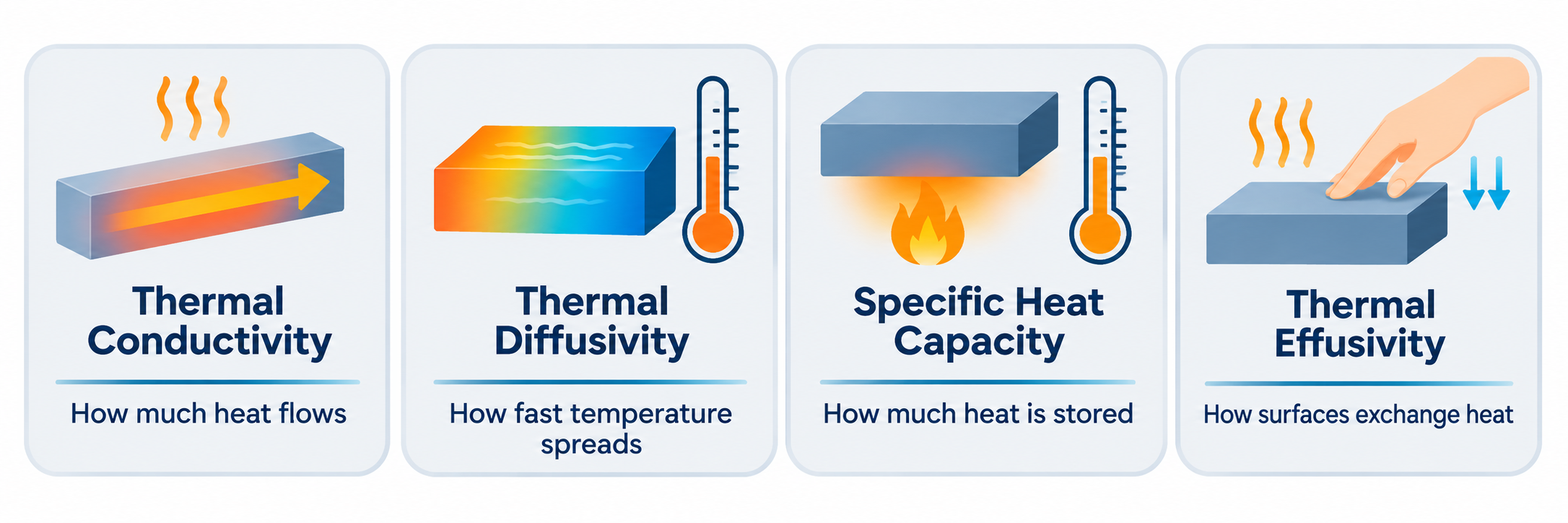
Ask how a material handles heat and you will get several different answers, because heat behavior is described by more than one property. Thermal conductivity, thermal diffusivity, specific heat capacity, and thermal effusivity each describe a different part of the story. They are related, and they are often confused. Together they make up the core thermal properties of materials, and using the wrong one for a design question can lead to wrong conclusions.
A simple way to keep them apart:
- Thermal conductivity: how much heat flows through a material.
- Specific heat capacity: how much heat a material stores as its temperature rises.
- Thermal diffusivity: how quickly a temperature change spreads through a material.
- Thermal effusivity: how strongly a material’s surface exchanges heat when something touches it.
This guide explains each property, compares them side by side, shows how they connect, and describes how the Hot Disk method measures them. For the wider picture of methods and equipment, see our guide to thermal conductivity measurement.
What Is Thermal Conductivity?
Thermal conductivity (k) describes how well a material conducts heat. Fourier’s law expresses it: the heat flux through a material is proportional to the temperature gradient across it, and k is the proportionality constant. It is measured in watts per meter per kelvin, W/(m·K).
A high value means heat passes through readily. Copper is about 400 W/(m·K). A low value means the material resists heat flow. Still air is about 0.026 W/(m·K), and typical polymers are roughly 0.1 to 0.5.
Thermal conductivity describes steady heat flow: how much heat moves through a given thickness for a given temperature difference. It does not tell you how fast a material heats up or cools down, because that also depends on how much heat the material stores. It can also change with temperature, density, moisture, composition, and direction.
What Is Thermal Diffusivity?
Thermal diffusivity (α) describes how quickly a temperature change travels through a material. It is conductivity divided by volumetric heat capacity:
α = k / (ρ × cp)
Here ρ is density and cp is specific heat capacity. The SI unit is m²/s, and values are often quoted in mm²/s.
A material with high diffusivity evens out its temperature quickly. With low diffusivity, temperature changes move slowly, so the surface and core can sit at different temperatures for a long time. Diffusivity matters whenever temperature changes over time, as in heating and cooling rates, heat spreaders, thermal shock, and pulsed heating.
Low conductivity does not always mean low diffusivity. Air conducts heat poorly, but it also stores very little heat per unit volume, so in conduction terms a temperature change spreads through it comparatively quickly.
What Is Specific Heat Capacity?
Specific heat capacity (cp) is the energy needed to raise the temperature of one kilogram of a material by one kelvin, in J/(kg·K). Water is about 4180 J/(kg·K), far above most solids. Copper is about 385.
A related quantity is volumetric heat capacity, ρ × cp, in J/(m³·K) or MJ/(m³·K). It describes heat stored per unit volume and is the form that appears in diffusivity and effusivity.
Unlike conductivity and diffusivity, specific heat capacity describes energy storage, not heat flow. It tells you how much energy a material absorbs as its temperature rises, but nothing about how fast heat moves. It also varies with temperature.
Common routes to specific heat include DSC and calorimetry. Barnett notes that the Hot Disk TPS 2500 S can also perform dedicated specific heat capacity testing of large solid samples, where DSC is limited by sample size. Hot Cell sensors target specific heat capacity of battery cells.
What Is Thermal Effusivity?

Thermal effusivity (e) describes how readily a material exchanges heat with whatever it touches:
e = √(k × ρ × cp)
Its unit is W·s½/(m²·K). It can also be written as e = k / √α, or ρ × cp × √α.
Effusivity explains why metal feels colder than wood at the same temperature. When two bodies touch, the interface temperature settles closer to the temperature of the material with the higher effusivity. For two bodies initially at uniform temperatures, the contact temperature is:
T_contact = (e₁ × T₁ + e₂ × T₂) / (e₁ + e₂)
Metal has high effusivity, so it pulls your skin’s surface temperature toward its own colder temperature. Wood has low effusivity, so your skin stays closer to its own temperature and the wood feels warmer. Effusivity matters for surface contact, thermal comfort, and thermal interface problems.
Thermal Conductivity vs. Thermal Diffusivity vs. Specific Heat Capacity
| Property | What it describes | Unit |
| Thermal conductivity | Ability to transfer heat | W/(m·K) |
| Thermal diffusivity | Rate of temperature propagation | m²/s |
| Specific heat capacity | Heat required to raise temperature | J/(kg·K) |
| Thermal effusivity | Ability to exchange heat with surroundings | W·s½/(m²·K) |
The key distinctions:
- Flow versus storage: conductivity describes heat flow, and specific heat capacity describes heat storage. They answer different questions.
- Diffusivity combines both: it is conductivity relative to how much heat the material stores.
- Effusivity combines them differently: it multiplies conductivity and storage, and it applies to surface contact.
- Comparing materials: a material can rank high on one property and low on another, so check the property that matches your question.
How Are These Thermal Properties Related?
The four properties are linked by density (ρ):
- α = k / (ρ × cp)
- k = α × ρ × cp
- ρ × cp = k / α
- e = √(k × ρ × cp) = k / √α
If you know conductivity and diffusivity, volumetric heat capacity follows directly, without needing density. Density is only needed to convert volumetric heat capacity into the mass-based specific heat capacity.
| Material | k (W/m·K) | cp (J/kg·K) | Density (kg/m³) | α (mm²/s) | e (W·s½/m²·K) |
| Copper | ~400 | ~385 | ~8960 | ~115 | ~37,000 |
| Stainless steel | ~15 | ~500 | ~7900 | ~3.8 | ~7,700 |
| Water (20 °C) | ~0.6 | ~4180 | ~1000 | ~0.14 | ~1,600 |
| Dry pine wood | ~0.12 | ~1700 | ~500 | ~0.14 | ~320 |
| Air | ~0.026 | ~1005 | ~1.2 | ~22 | ~6 |
The table shows how the properties differ:
- Water has by far the highest specific heat capacity, but its conductivity is low.
- Air has very low conductivity but a comparatively high diffusivity, because it stores so little heat per unit volume.
- Wood and water have nearly the same diffusivity but very different effusivity, so diffusivity alone would hide the difference.
- Copper is high on every column except specific heat, which is why it moves and exchanges heat so readily.
Why Are These Properties Important in Material Characterization?
No single property gives the full picture. Which one matters depends on the question:
| Question | Property that matters |
| How much heat flows through an insulating layer at steady state? | Thermal conductivity |
| How quickly will a component’s core heat up or cool down? | Thermal diffusivity |
| How much energy does it take to heat a part by a given amount? | Specific heat capacity |
| How will a surface feel or behave on contact? | Thermal effusivity |
Together they also support:
- Complete models: transient thermal simulations need conductivity and heat capacity, not conductivity alone.
- Material comparison: two materials with the same conductivity can behave very differently in a transient situation.
- Quality control: a shift in any one property can reveal a change in composition, density, or structure.
- Direction and temperature effects: conductivity and diffusivity can differ by direction in layered or fibrous materials, and all four properties can change with temperature.
How Does the Hot Disk Method Measure Thermal Properties?
The Hot Disk method uses the transient plane source (TPS) technique. A flat sensor acts as both heater and thermometer. It records its own temperature rise while heat flows into the sample, and the software fits that response to give thermal conductivity and thermal diffusivity. Volumetric heat capacity follows as k / α, and effusivity follows from conductivity and volumetric heat capacity.
Barnett’s Isotropic Standard Module lists measurement of thermal conductivity, diffusivity, effusivity, and specific heat capacity of isotropic bulk samples, including solids, liquids, powders, and pastes. Hot Disk results for specific heat are expressed per unit volume. For example, Barnett lists specific heat capacity for the TPS 2500 S up to 5 MJ/m³K, and a mass-based value needs the sample’s density.
When specific heat capacity is the main goal, the Specific Heat Capacity Measurement Module offers dedicated testing. The method follows ISO 22007-2, and our ASTM E3088-25 news post covers the newer ASTM standard.
Other techniques measure these properties individually. Laser flash analysis targets diffusivity, and DSC is a common route to specific heat. For the full TPS walk-through, see our TPS method explainer. For a comparison of methods, see our guide to thermal conductivity testing methods.
Applications Across Different Industries
- Electronics and semiconductors: conductivity governs how well heat spreads from a device, and diffusivity matters for short power pulses. Barnett’s Thin Film Measurement Module covers through-plane conductivity of insulating films and coatings.
- Batteries and energy storage: specific heat capacity affects how fast a cell warms under load, and conductivity affects how well heat dissipates. Hot Cell sensors address specific heat capacity of whole cells.
- Building and insulation: conductivity is the central property for insulation. Volumetric heat capacity (thermal mass) and effusivity influence how a space responds to temperature swings and how surfaces feel.
- Polymers and composites: fillers and fibers change conductivity and can make it direction-dependent. Barnett’s thermoplastic filler study found that conductivity did not scale linearly with filler loading.
- Metals and ceramics: high conductivity and high diffusivity let temperature gradients even out quickly. Diffusivity also influences how quickly gradients, and the thermal stresses they cause, develop.
- Aerospace and automotive: lightweight composites and heat-tolerant components need several properties together to model heating, cooling, and thermal protection.
Frequently Asked Questions
Is thermal diffusivity the same as thermal conductivity?
No. Diffusivity is conductivity divided by volumetric heat capacity (α = k / (ρ × cp)). It describes how fast temperature changes spread, not how much heat flows.
Can a material have low conductivity but high diffusivity?
Yes. Air has very low conductivity but stores so little heat per unit volume that temperature changes spread through it comparatively quickly.
What is the difference between specific heat and heat capacity?
Specific heat capacity is per unit mass, in J/(kg·K). Heat capacity of a whole object is its total value in J/K. Volumetric heat capacity is per unit volume.
How are the four properties related?
Through density: α = k / (ρ × cp), and e = √(k × ρ × cp).
Which property do I need for steady-state versus transient problems?
Steady-state heat flow depends mainly on conductivity. Transient problems also depend on heat capacity, so they involve diffusivity and effusivity.
Can one measurement give all the properties?
A TPS measurement gives conductivity and diffusivity, and volumetric heat capacity and effusivity follow from them. A mass-based specific heat capacity also needs density, and dedicated modules are available when specific heat is the main goal.
Do I need to know density?
Not for conductivity, diffusivity, or volumetric heat capacity by TPS. You need it to convert volumetric heat capacity to a mass-based value.
Can Barnett measure these properties on my samples?
Yes. Barnett offers thermal testing services using Hot Disk instruments, either on-site or through the manufacturer.
Measure the Thermal Properties of Your Materials
Barnett Technical Services is an authorized distributor of Hot Disk thermal analyzers. Browse our thermal constants analyzers, or request information or contact us to discuss your materials and measurement goals.
Related reading:
Related products: