
Transient Plane Source (TPS): A Modern Approach to Thermal Conductivity Measurement
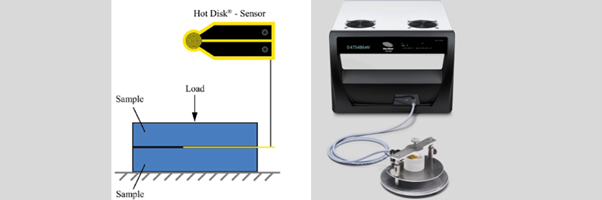
As materials become more advanced and application demands grow more complex, accurately measuring thermal properties has become increasingly critical. The Transient Plane Source (TPS) method has emerged as a reliable, fast, and highly adaptable solution for thermal conductivity testing and related thermal property measurements across a wide range of materials.
Originally developed to overcome the limitations of traditional steady-state techniques, TPS is now an internationally recognized method, widely used in research, development, and quality control laboratories.
Why Thermal Conductivity Measurement Is Critical
Thermal conductivity describes how efficiently heat moves through a material when exposed to a temperature difference. This property directly impacts performance, safety, and reliability in applications such as:
- Electronic device cooling
- Battery thermal management
- Aerospace and automotive components
- Insulation and building materials
- Advanced polymers and composites
Materials with high thermal conductivity are essential for efficient heat dissipation, while low-conductivity materials are required for effective thermal insulation. Selecting the right material—and validating its properties – depends on accurate and repeatable thermal conductivity measurement methods.
Beyond Thermal Conductivity: Key Thermal Properties
Heat transfer behavior cannot be fully described by thermal conductivity alone. TPS thermal conductivity testing enables evaluation of additional properties that influence real-world performance:
- Thermal Diffusivity – how quickly heat spreads through a material
- Volumetric Heat Capacity – how much heat a material can store per unit volume
- Thermal Effusivity – how readily a material exchanges heat with its surroundings
- Anisotropy – Differences in the thermal properties of a solid material in different directions
Together, these properties provide a comprehensive understanding of thermal behavior under dynamic operating conditions.
Limitations of Traditional Thermal Conductivity Testing Methods
Before TPS, laboratories primarily relied on steady-state and early transient techniques such as:
- Guarded hot plate
- Heat flow meter
- Laser flash analysis
While effective in specific scenarios, these methods often present challenges:
- Long test durations
- Strict sample size and geometry requirements
- Difficulty measuring low-conductivity or anisotropic materials
- Limited suitability for layered or inhomogeneous samples
As materials became more complex- particularly polymers, composites, and battery components- the need for a faster and more flexible testing method became increasingly clear.

What Is the Transient Plane Source (TPS) Method?
The Transient Plane Source (TPS) method is a non-destructive, transient thermal measurement technique that uses a flat, double-spiral sensor acting simultaneously as a heat source and a temperature sensor.
Measurement Process:
- The sensor is placed between two sample surfaces or on a single surface with a known backing material
- A controlled electrical current is applied to the sensor
- The resulting temperature rise is recorded as a function of time
- Thermal conductivity and thermal diffusivity are calculated from the transient temperature response
This approach enables multiple thermal properties to be determined from a single, short measurement, without requiring steady-state conditions.
How TPS Thermal Conductivity Testing Works
During a TPS measurement:
- A known electrical power is applied for a defined time interval
- The sensor continuously records temperature change
- Mathematical models analyze the transient response to determine thermal properties
Because TPS does not require prolonged thermal equilibrium, measurements can be completed in seconds to minutes-significantly improving laboratory efficiency while maintaining high accuracy.
Sensor Design and Measurement Configurations
TPS sensors are constructed as double-spiral conductive elements embedded within electrically insulating layers. This design provides:
- Uniform heat distribution
- High sensitivity to temperature changes
- Reduced influence from sample size limitations
Depending on the material, measurements can be performed using:
- Symmetric testing – sensor placed between two identical samples
- Asymmetric testing – sensor placed on one surface with a backing material
This flexibility allows TPS to measure bulk solids, thin samples, liquids, powders, and soft materials using the same fundamental technique.
Advantages of TPS Over Conventional Thermal Conductivity Methods
1. Rapid Measurements Without Steady-State Conditions
TPS eliminates the need for thermal equilibrium, enabling fast measurements that dramatically improve lab productivity.
2. Minimal Sample Preparation
A wide range of sample sizes, thicknesses, and surface conditions can be tested with minimal preparation.
3. Broad Material Compatibility
TPS can measure:
- Solids, liquids, and powders
- Polymers, ceramics, metals, and composites
- Low- and high-conductivity materials
This versatility makes TPS particularly valuable for R&D environments working with diverse material systems.
4. Accurate Testing of Anisotropic and Inhomogeneous Materials
TPS supports directional thermal conductivity measurement, making it ideal for:
- Layered composites
- Fiber-reinforced materials
- Battery electrodes and separators
5. Simultaneous Measurement of Multiple Properties
Thermal conductivity, thermal diffusivity, and volumetric heat capacity can be obtained from a single experiment, improving data consistency and reducing test time.
TPS for Anisotropic and Advanced Materials
Many modern materials exhibit anisotropy, meaning thermal conductivity varies by direction. TPS enables directional measurements by controlling sensor orientation and test configuration, providing data that is essential for thermal modeling and system-level design.
Why TPS Is Widely Adopted Across Industries
Electronics & Thermal Management: TPS enables rapid evaluation of thermal interface materials, substrates, and heat-spreading components critical for device reliability.
Energy Storage & Battery Research: Accurate thermal characterization supports improved battery performance, safety, and lifespan without destructive testing.
Aerospace & Automotive: Lightweight composites and advanced alloys require precise and repeatable thermal data across complex material structures.
Construction & Insulation: Low-conductivity materials such as foams and insulation benefit from TPS’s sensitivity and repeatability.
TPS as an Internationally Recognized Method
The Transient Plane Source (TPS) method is internationally recognized and formally standardized for thermal transport property measurement. It is defined under ISO 22007-2 for the determination of thermal conductivity and thermal diffusivity, and under ISO 22007-7 for the direct measurement of thermal effusivity using a plane heat source technique.
In addition to ISO standardization, the TPS method has received further validation through ASTM E3088-25, which specifies test methods for measuring thermal conductivity and thermal diffusivity of solid materials using a double-spiral configuration of the transient plane source method. This ASTM standard expands the applicability of TPS testing beyond plastics to a broad range of isotropic and anisotropic solid materials.
Together, these international standards confirm the TPS method’s accuracy, repeatability, and broad applicability – making it a trusted choice in both academic research and industrial laboratories worldwide.
Final Thoughts on TPS Method
The Transient Plane Source (TPS) method represents a major advancement in thermal conductivity testing, combining speed, accuracy, and versatility in a single, non-destructive measurement technique. Its ability to evaluate multiple thermal properties across a wide range of materials makes TPS an essential tool for modern research, product development, and quality control laboratories.
As material systems continue to evolve and thermal management challenges become more demanding, reliable measurement techniques are critical. Barnett Technical Services takes immense pride in being an Authorized Distributor of Hot Disk® instruments, supporting laboratories with proven TPS technology, application expertise, and trusted technical guidance. Together, TPS methodology and Hot Disk® instrumentation provide a future-ready solution for accurate and dependable thermal analysis.