
Compact Fixturing for Securely Holding Small Parts During Precision Micro-Work
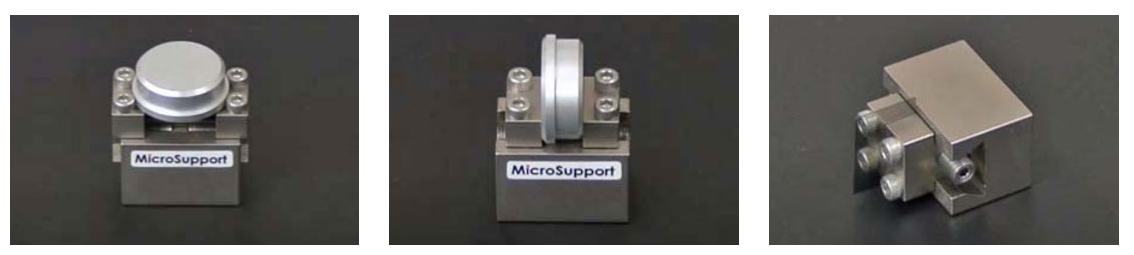
Small components and thin metal parts are hard to hold steady. A very small part offers little surface to grip. It can shift when touched, and under a microscope even a slight movement looks large. That makes inspection and manipulation harder than it needs to be.
Stable sample fixation is therefore a basic part of any precision micro-workflow, including microsampling. A compact vise gives the sample a dedicated holding point and keeps the working surface open for the tools and optics that do the actual work. MicroSupport’s Pocket Vice PV-1 is a compact tabletop vise built for this purpose.
Why Stable Holding Is Important for Small Components
Positioning small parts and plate materials is a challenge in its own right. A part that is not held securely can drift, tilt, or move when a tool touches it. That makes it harder to keep the target area in view and to approach it accurately.
Two things matter when fixing a sample:
- Stability: The sample needs to stay in place during inspection and during any follow-on micro-operation.
- Orientation: The sample needs to be held so the required surface or edge is accessible. The right orientation depends on the part’s geometry and the task.
A fixture secures the sample. It does not inspect, probe, sample, or process it. Those jobs belong to other tools, and the fixture’s role is to make them easier to do well.
MicroSupport Pocket Vice for Compact Sample Fixation
Compact Tabletop Vise
The Pocket Vice PV-1 is a compact tabletop vise designed to hold small samples securely. Its cube-shaped structure lets the sample be fixed either horizontally or vertically, so the same fixture can serve different orientation needs. The manufacturer also notes that the vise’s open/close handle is detachable, which keeps the unit compact while in use.
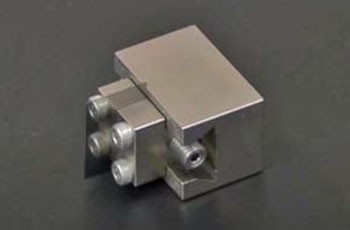
Vertical Sample Fixation
MicroSupport’s application example demonstrates vertical sample fixation. Holding a part upright can bring a selected surface or edge into a more accessible position for later work. Whether vertical or horizontal fixing is the better choice depends on the component’s geometry and what needs to be done to it.
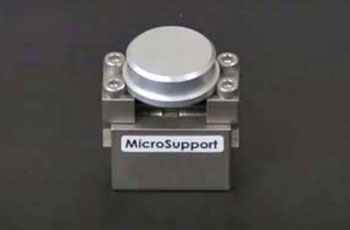
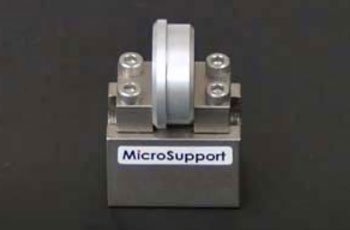
Caption: A small round part fixed horizontally (left) and vertically (right) in the
Compact Design for the Workbench
Bench space around a microscope is often limited, so a compact fixture is a practical advantage. The manufacturer specifies the PV-1 as follows:
- Weight: 100 g
- Maximum grip width: 17 mm
- Maximum grip depth: 8 mm
These are specifications of the vise itself. They are not a general range of sample sizes, so a part’s dimensions should be checked against them before it is selected for fixation.
Securing Small Metal and Electronic Components
MicroSupport associates the Pocket Vice application with several categories of parts that may need secure fixation:
- Metal parts
- Electronic components
- Circuit boards
- Connectors
- Sockets
- Capacitors
- Automotive parts
- Small plate materials
These are the application areas the manufacturer lists. They are not a claim that each one was individually shown in the application video.
How Compact Fixturing Supports Precision Micro-Work
Fixturing fits into a precision workflow in a simple sequence:
Position → Secure → Inspect → Perform the Micro-Operation → Inspect Again
- Position: Place the small component in the orientation the intended operation requires.
- Secure: Fix the component firmly in the Pocket Vice.
- Inspect: Use suitable microscopy or magnification to confirm the target area and the sample’s position.
- Perform the micro-operation: Use the appropriate MicroSupport micro-tool, probe, or micromanipulator for the specific task.
- Inspect again: Check the sample and working area after the operation.
Technical clarification: The Pocket Vice is the holding component of this workflow. It does not provide micromanipulator movement, and it does not perform the micro-operation.
Combining Sample Fixation with Micromanipulation
A securely held sample makes controlled tool positioning easier, because the target stays where it was located. Fixation and micromanipulation are complementary, but each piece of equipment has its own function:
| Component | Primary Function |
| Pocket Vice | Secures the small sample or part |
| Micromanipulator | Provides controlled movement and positioning of the micro-tool |
| Micro-tool / probe | Performs the specific sampling, probing, cutting, manipulation, or other operation |
| Microscope | Provides visual observation of the working area |
Barnett’s MicroSupport systems illustrate this combination. The Axis Pro, for example, integrates a zoom microscope with motorized manipulator arms, and tools such as probes, knives, and scrapers can be used with those arms for microscopic sample handling. The Pocket Vice sits at the start of that chain by holding the part in place.
Application Example: Compact Securing of Micro Parts
MicroSupport documents this application as follows:
- Sample: Small parts and plate materials
- Tool: Pocket Vice
- Application: Vertical sample fixation
- Feature: Compact tabletop vise
In this application, the Pocket Vice is used for vertical sample fixation of small parts and plate materials in a compact tabletop format. Stable fixation like this prepares the sample for whatever precision work comes next. The documented application covers fixation only, and it does not include cutting, sampling, inspection, or measurement steps.
Applications Where Secure Micro-Part Holding Is Useful
Secure sample fixation can support work such as:
- Electronic component inspection
- Circuit board inspection
- Small metal part inspection
- Connector and socket inspection
- Capacitor handling and inspection
- Automotive component work
- Microscopic sample preparation
- Precision material evaluation
These are potential uses of secure sample fixation. In each case the vise holds the part, and other equipment carries out the inspection or analysis.
Selecting an Appropriate Holding Method
Choosing how to hold a part depends on several factors:
- Part dimensions: Does the part fit the fixture?
- Part geometry: Does the shape allow it to be gripped securely?
- Material: How will the part respond to being gripped?
- Required orientation: Does the work need the part flat, upright, or at another angle?
- Surface that must stay accessible: Will the fixture block the working area?
- Required tool approach: Is there room for the tool to reach the target?
- Available workspace: Does the fixture fit the bench and microscope setup?
- Stability requirements: How much stability does the operation demand?
- Risk of damage: Excessive clamping force can damage delicate parts.
For the PV-1, the manufacturer’s 17 mm maximum grip width and 8 mm maximum grip depth define which parts it can hold. Confirm a part’s dimensions against these limits before choosing the fixture.
Best Practices for Securing Small Parts
- Confirm dimensions first: Check the part against the fixture’s specifications before selecting it.
- Keep the work area accessible: Position the component so the target surface stays reachable.
- Secure firmly, not forcefully: Hold the sample firmly without applying unnecessary force.
- Verify stability: Confirm the part is stable before starting precision work.
- Check the field of view: Make sure the fixture does not obstruct the microscope view.
- Confirm tool clearance: Make sure there is room for the selected micro-tool.
- Consider material and geometry: Let the sample’s properties guide the holding arrangement.
- Recheck during repeated contact: If the operation involves repeated tool contact, check stability again.
Key Benefits of Compact Micro-Part Fixturing
- Secure holding of small parts and plate materials
- Horizontal or vertical sample fixation
- Compact tabletop configuration
- Efficient use of bench space
- Improved access to the working surface
- Support for electronic and metal component workflows
- Compatibility with broader microscopic inspection and micromanipulation workflows
Horizontal and vertical fixation and the compact design are manufacturer-documented features of the Pocket Vice.
Small components and plate materials need to stay still during precision work, and stable fixation is what makes careful inspection and manipulation possible. The Pocket Vice PV-1 offers a compact way to hold these samples, with horizontal or vertical fixing in a small tabletop design. It is one part of a larger workflow. The appropriate microscopy, micromanipulation, and micro-tools are then chosen to suit the specific application.
Barnett Technical Services provides MicroSupport holding tools, micromanipulators, and precision micro-tools for secure sample positioning and microscopic work. Contact us to discuss the right solution for your small-part handling, inspection, or micro-sampling application.