
Pinpoint Collection of Foreign Particles in Paper Fibers (30–100 µm) Using Precision Micro-Manipulation
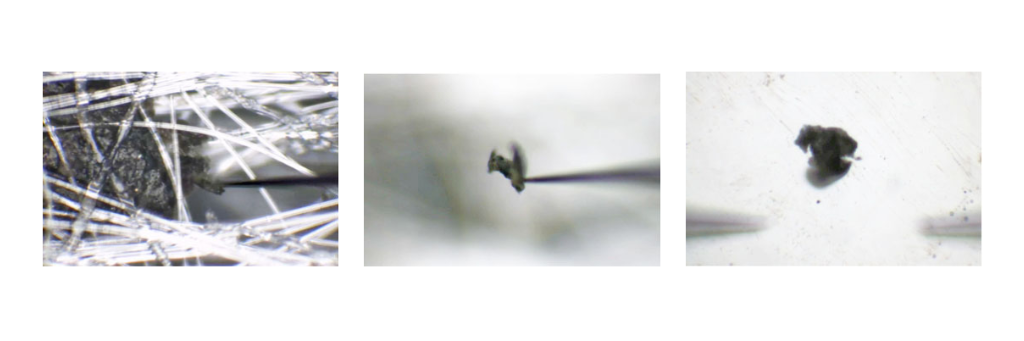
Image Credit: https://www.microsupport.co.jp/
Contamination analysis in paper manufacturing, packaging materials, specialty papers, and research applications often begins with detecting a foreign particle. However, identifying contamination is only part of the process. To determine its composition, source, and potential impact, the particle must first be collected from the paper structure without introducing contamination or altering the particle.
This can be challenging because foreign particles may become trapped within the paper’s fibrous network, making them difficult to access and isolate. At the same time, preserving particle integrity is critical for reliable downstream analysis using techniques such as Raman spectroscopy, FTIR, and SEM.
This is where precision micro-manipulation becomes valuable. Systems such as the MicroSupport AxisPro provide controlled micro-manipulation under microscopic observation, allowing operators to locate, isolate, and extract individual particles with high positional accuracy. The result is a highly controlled, non-destructive collection process that improves extraction accuracy, preserves sample integrity, and supports reliable analytical outcomes.
This post explains the challenges of collecting foreign particles from paper fibers, the limitations of conventional extraction methods, the role of precision micro-manipulation in improving particle recovery, the capabilities of AxisPro, recommended collection workflows, key applications, and best practices for reliable contamination analysis.
Understanding the Structure of Paper Fibers
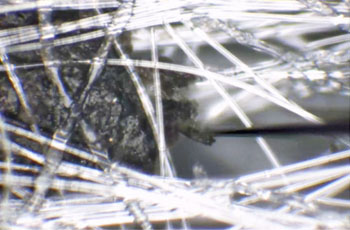
Image Credit: https://www.microsupport.co.jp/
To understand why foreign particle collection is challenging, it is important to first understand the structure of paper itself.
Unlike a smooth, solid surface, paper consists of an interconnected network of fibers, primarily composed of cellulose. These fibers overlap, intertwine, and create irregular voids throughout the material. Depending on the paper grade, manufacturing process, fiber composition, and thickness, the internal structure can vary significantly.
The following characteristics of paper make foreign particle collection particularly challenging:
- Interwoven Fiber Network: Paper contains a complex arrangement of fibers that create a three-dimensional structure rather than a flat surface. This network can trap contaminants beneath or between fibers.
- Variable Pore Spaces: The spaces between fibers vary in size and shape, allowing particles to become lodged at different depths within the material.
- Limited Accessibility: Particles embedded within the fibrous matrix are often partially obscured by surrounding fibers, making direct access difficult.
- Microscopic Particle Dimensions: Foreign particles in the 30–100 µm range are small enough to become deeply embedded within fiber structures while remaining difficult to isolate individually.
- Reduced Visibility: Even under magnification, distinguishing a particle from surrounding fibers may require careful observation and positioning.
In paper samples with thicknesses of approximately 100 µm or greater, contaminants may become embedded below the visible surface, further increasing extraction complexity.
Challenges in Collecting Embedded Micro Particles
Collecting foreign particles from paper fibers requires significantly greater precision than simply locating them. Once a contaminant has been identified, the extraction process introduces a new set of challenges as follows:
- Difficulty Isolating Individual Particles: Foreign particles are often trapped within a dense network of interwoven fibers. Separating a single particle without disturbing adjacent fibers or neighboring contaminants can be challenging, particularly when the particle is partially embedded below the paper surface.
- Risk of Particle Displacement: Microscopic particles may shift position with even minimal mechanical contact. During extraction, unintended movement may cause the particle to relocate within the fiber network, making recovery more difficult and potentially altering the original contamination evidence.
- Risk of Particle Loss: Small contaminants can easily detach from the substrate during collection. Once displaced, particles in the 30–100 µm range may become difficult to relocate, resulting in incomplete investigations or the loss of critical analytical information.
- Fiber Deformation or Damage: Excessive force applied during extraction can deform, compress, or tear surrounding paper fibers. Such damage may alter the contamination site and eliminate valuable information regarding how the particle became embedded within the material.
- Contamination During Handling: Improper tools, uncontrolled environments, or excessive sample contact can introduce additional contaminants. These foreign materials may interfere with downstream analytical techniques and complicate contamination source identification.
- Positioning Challenges Under Magnification: Successful particle collection requires stable positioning and precise tool alignment under continuous microscopic observation. Any vibration or unintended movement can reduce extraction accuracy and increase the likelihood of disturbing the particle or surrounding fibers.
Limitations of Conventional Collection Methods
Traditional collection techniques are often suitable for larger contaminants located on exposed surfaces. However, when particles become embedded within paper fibers, these methods frequently lack the precision and control necessary for reliable extraction.
The following limitations often reduce the effectiveness of conventional particle collection techniques:
- Insufficient Precision for Micro-Scale Extraction: Standard laboratory tweezers, probes, and handling tools are typically not designed for manipulating particles in the 30–100 µm size range. Their relatively large contact areas can make selective extraction difficult and increase the risk of disturbing surrounding fibers.
- Uncontrolled Contact Forces: Manual collection methods provide limited control over the force applied during extraction. Excessive force can damage the paper substrate, while insufficient force may fail to disengage the particle from the surrounding fiber network.
- Adhesive-Induced Contamination: Tape lifts and adhesive collection techniques may leave residues on the particle surface or introduce additional materials that can affect subsequent analysis. Such contamination can interfere with Raman spectroscopy, FTIR analysis, SEM imaging, and other characterization methods.
- Limited Selectivity: Dense fiber networks often contain multiple particles, fibers, and surface features in proximity. Conventional methods frequently struggle to isolate a specific target particle without affecting adjacent material.
- Reduced Repeatability: Collection success often depends heavily on operator experience and technique. Variations in handling methods can lead to inconsistent extraction quality and reduced reproducibility between investigations.
- Difficulty Accessing Embedded Particles: Particles located beneath surface fibers may be partially concealed or physically inaccessible using standard collection tools. This limitation can prevent complete recovery of embedded contaminants.
- Higher Risk of Sample Alteration: Direct mechanical interaction with both the particle and substrate increases the likelihood of modifying particle morphology, surface characteristics, or the surrounding contamination environment.
As particle size decreases and substrate complexity increases, achieving reliable collection often requires tools capable of controlled micro-scale manipulation under microscopic observation.
Advanced Micro-Manipulation for Embedded Particle Extraction
Precision micro-manipulation addresses many of the challenges associated with collecting 30–100 µm foreign particles embedded within fibrous materials such as paper. The following capabilities make precision micro-manipulation an effective solution for particle extraction from paper:
- Micrometer-Scale Movement Control: High-resolution positioning systems enable highly controlled movement adjustments, allowing operators to approach, isolate, and extract particles with a high degree of precision.
- Targeted Particle Access: Under direct microscopic observation, operators can selectively target individual particles embedded within the fiber network without affecting nearby contaminants or surrounding structures.
- Controlled Interaction with Fibers: Precision manipulation tools enable gradual and controlled separation of fibers surrounding the particle, reducing the likelihood of substrate damage during extraction.
- Non-Destructive Collection: Carefully controlled extraction procedures preserve both particle morphology and paper fiber integrity, supporting more reliable contamination investigations and material characterization.
- Improved Process Consistency: Stable positioning and controlled motion can reduce operator-dependent variability, resulting in more repeatable extraction workflows and improved consistency between investigations.
- Enhanced Visual Guidance: Continuous microscope integration provides real-time visual feedback throughout the extraction process, improving targeting accuracy and reducing the risk of particle loss.
- Compatibility with Analytical Workflows: Precision-collected particles can be transferred for Raman spectroscopy, FTIR, SEM, EDS, and other advanced analytical techniques without introducing unnecessary handling steps.
Pinpoint Particle Collection Using AxisPro
AxisPro is a precision micro-manipulation system designed to support the handling, positioning, and extraction of microscopic particles under direct microscopic observation. Its combination of high-resolution motion control, microscope integration, and specialized micro-tools makes it well suited for collecting foreign particles in the 30–100 µm range from complex fibrous materials such as paper.
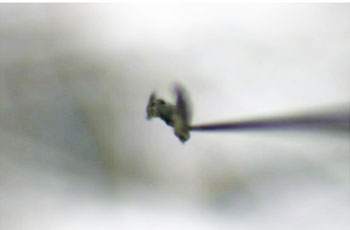
Image Credit: https://www.microsupport.co.jp/
Key capabilities that enable AxisPro to perform accurate and non-destructive particle collection from paper fibers:
- Fine XYZ Control for Precise Positioning: Independent X, Y, and Z movement control allows operators to position extraction tools accurately relative to the target particle. This level of positioning accuracy is particularly valuable when working within complex fiber networks where even minor movement errors can affect extraction success.
- High-Resolution Motion Control: Micron-level positioning resolution enables extremely small movement adjustments during particle isolation procedures. Fine control improves targeting accuracy while reducing unintended interaction with adjacent fibers and surrounding material.
- Micro-Needles and Probe-Based Tools: Specialized micro-needles and probe-based tools provide controlled access to particles embedded within paper fibers. Their small dimensions allow operators to work within confined spaces while maintaining precise manipulation control.
- Controlled Separation from Surrounding Fibers: Particles can be carefully disengaged from surrounding fibers using controlled tool movement rather than excessive mechanical force. This approach minimizes disturbance to the paper structure while improving extraction accuracy.
- Preservation of Particle Integrity: Accurate manipulation reduces mechanical stress during collection, helping preserve the particle’s morphology and surface characteristics for subsequent analytical evaluation.
- Preservation of Substrate Integrity: Controlled extraction minimizes fiber deformation, tearing, or displacement, allowing investigators to retain valuable contextual information about the contamination event and particle location.
- Stable Operation Under Magnification: The system is designed to provide stable positioning throughout the collection process.Stable operation improves manipulation accuracy and reduces the likelihood of unintended particle movement during extraction.
- Repeatable Collection Workflows: Consistent positioning and motion control can improve workflow repeatability across multiple samples, operators, and contamination investigations.
Step-by-Step Workflow for Particle Collection
The following workflow illustrates how AxisPro can be used to support controlled and non-destructive collection of foreign particles embedded within paper fibers.
- Locate the Foreign Particle Using an Optical or Digital Microscope: The operator first identifies the target particle under appropriate magnification. High-quality imaging improves visibility, helps confirm particle size, and reveals how the contaminant is positioned within the surrounding fiber network.
- Align the Micro-Manipulation Tool with the Particle Position: Using precision XYZ positioning controls, the extraction tool is carefully aligned relative to the target particle. Stable positioning ensures accurate tool placement while maintaining continuous microscopic observation.
- Carefully Separate the Particle from Surrounding Fibers: Micro-needles or probe-based tools are used to gently disengage fibers surrounding the particle. Controlled manipulation minimizes substrate disturbance while creating a clear extraction path.
- Extract the Particle Using Controlled, Precise Movement: Once adequately isolated, the particle is removed using smooth and controlled motion. Precise movement control helps prevent particle displacement, loss, or mechanical damage during collection.
- Transfer the Particle for Analysis: The collected particle is transferred to a suitable substrate or sample holder and prepared for characterization using techniques such as Raman spectroscopy, FTIR, SEM, EDS, or other analytical methods.
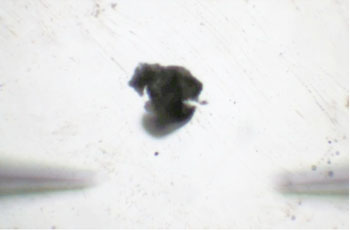
Image Credit: https://www.microsupport.co.jp/
Applications and Use Cases for Precision Particle Collection in Paper Fibers
The following applications commonly benefit from precise collection of foreign particles embedded within paper fibers:
- Paper and Packaging Quality Control: Manufacturers use precision particle collection to identify contaminants that may affect product appearance, print quality, performance, or compliance with customer specifications.
- Contamination and Defect Analysis: Accurate particle isolation supports root-cause investigations involving process contamination, raw material impurities, and manufacturing defects.
- Specialty Paper Manufacturing: High-value paper products, including filtration media, technical papers, and specialty packaging materials, often require detailed contamination analysis to maintain strict quality standards.
- Materials Research: Researchers studying fibrous materials use precision extraction techniques to isolate embedded particles for characterization, composition analysis, and material performance investigations.
- Forensic Investigations: Controlled particle collection helps recover trace evidence from documents, packaging materials, and paper-based samples while preserving the integrity of both the particle and substrate.
- Failure Analysis Laboratories: Analytical laboratories frequently isolate microscopic contaminants to support investigations into failure mechanisms, contamination sources, and process-related issues.
- Environmental Monitoring Studies: Precision extraction can support investigations involving airborne particulate contamination and particle captured on fibrous or paper-based collection substrates.
- Academic and Research Institutions: Universities and research organizations use micro-manipulation systems to support experimental studies involving fibers, contaminants, micro-particles, and advanced analytical techniques.
Best Practices for Micro-Particle Handling
Successful particle collection depends on a combination of precision equipment, proper technique, and controlled operating conditions. The following best practices help improve extraction accuracy, preserve sample integrity, and enhance analytical reliability:
- Perform Operations Under Appropriate Magnification: Use sufficient optical magnification to clearly visualize the target particle, surrounding fibers, and extraction tool. Inadequate visibility can lead to positioning errors, incomplete recovery, or unintended substrate disturbance.
- Use Stable Positioning Systems: Maintain precise tool alignment throughout the extraction process. Uncontrolled vibration or movement can reduce positioning accuracy and increase the risk of particle displacement.
- Apply Gentle, Controlled Movements: Use small, deliberate tool movements when separating particles from surrounding fibers. Excessive force can damage fibers, alter particle morphology, or cause particle loss.
- Select Appropriate Micro-Tools: Choose micro-needles, probes, or specialized extraction tools suited to the particle size and accessibility requirements. Using oversized or unsuitable tools can compromise extraction precision.
- Minimize Disturbance to Surrounding Fibers: Focus interaction on the target particle whenever possible. Unnecessary contact with adjacent fibers can alter the contamination environment and complicate analysis.
- Maintain a Clean Working Environment: Control airborne contamination and limit unnecessary sample handling to preserve particle integrity and prevent the introduction of secondary contaminants.
- Document Collection Procedures: Capture images or video during extraction whenever practical to support traceability, reporting, and contamination investigations.
- Verify Particle Recovery Before Analysis: Confirm successful particle transfer and retention before proceeding with Raman spectroscopy, FTIR, SEM, EDS, or other analytical techniques to help avoid incomplete analytical data.
Precision Particle Collection Starts with the Right Tools
Collecting foreign particles embedded within paper fibers requires more than simply locating contamination.Precision micro-manipulation provides a controlled and reliable approach to particle collection. By combining microscope-guided observation with precise positioning control, systems such as AxisPro support accurate, non-destructive extraction of embedded particles while helping preserve both particle integrity and substrate condition.
Take control of micro-particle collection with precision micro-manipulation solutions. Connect with Barnett Technical Services to explore the AxisPro system and identify the right tools for accurate particle extraction, controlled handling, and reliable analytical workflows.