
Precision Micro-Particle Handling: From Targeted Particle Extraction to Vacuum Transfer of Industrial Particles
Handling microscopic particles presents significant challenges in analytical, research, and industrial environments. At micro-scale dimensions, external influences such as vibration, electrostatic forces, and airflow can affect particle stability and positioning, making accurate manipulation difficult. As a result, many applications require reliable methods for identifying individual particles, extracting them without compromising sample integrity, and transferring them to a designated location for further processing or analysis.
Precision micro-manipulation and vacuum-based handling technologies provide the control needed to perform these tasks while minimizing particle loss, contamination, and positioning errors. By combining high-resolution imaging, precise movement control, and application-specific handling tools, these systems support repeatable and efficient micro-particle workflows. This post explores two practical approaches to precision particle handling: single-particle extraction using the AxisPro micromanipulation system and vacuum-assisted transfer of industrial diamond particles. It highlights the tools, workflows, and capabilities that support accurate particle selection, extraction, transfer, and preparation for downstream analysis.
The Core Requirements: Selection, Extraction, and Transfer
Effective micro-particle handling depends on three interconnected stages: identification and selection, controlled extraction, and accurate transfer. Each stage plays an important role in maintaining particle integrity, positional accuracy, and workflow repeatability.
- Identification and Selection: The first step is to identify the target particle and confirm that it meets the required selection criteria.
- Locate the target particle within the field of view.
- Verify particle characteristics using visual inspection and dimensional measurement.
- Differentiate the target particle from surrounding particles, debris, or contaminants.
- Controlled Extraction: Once identified, the particle must be isolated and removed without compromising its condition or disturbing adjacent material.
- Separate the selected particle from its substrate or surrounding matrix.
- Minimize the risk of damage, deformation, or contamination during removal.
- Maintain stable manipulation despite microscale forces such as adhesion and electrostatic effects.
- Transfer and Placement: After extraction, the particle must be transferred to the required destination for further processing or analysis.
- Move the particle to a designated substrate, vessel, or analysis location.
- Maintain particle integrity and positional control during transfer.
- Support accurate placement for downstream analytical or processing workflows.
Why This Process is Challenging at Micro Scale
Several factors can complicate particle selection, extraction, and transfer, particularly when using conventional handling methods.
- Electrostatic charge and surface adhesion can influence particle behavior and movement.
- Airflow generated during handling may displace lightweight particles.
- Microscopic particles can shift unexpectedly as manipulation tools approach the target.
- Excessive force may damage fragile particles or surrounding material.
- Limited real-time visual feedback can increase the risk of inaccurate particle selection or handling.
Essential Capabilities for Precision Micro-Particle Handling
Effective micro-particle handling systems require several key capabilities to support accurate particle selection, extraction, and transfer.
- High-resolution visualization to support accurate particle identification and targeting.
- Precise positional control to enable stable and repeatable particle manipulation.
- Application-specific pickup mechanisms, including contact-based and vacuum-based tools, for reliable particle extraction and transfer.
The most appropriate handling method depends on factors such as particle size, material characteristics, required precision, and workflow objectives. The following applications demonstrate how these capabilities support two common micro-particle handling tasks: extraction of a single ink particle from a friction pen and vacuum-assisted transfer of industrial diamond particles.
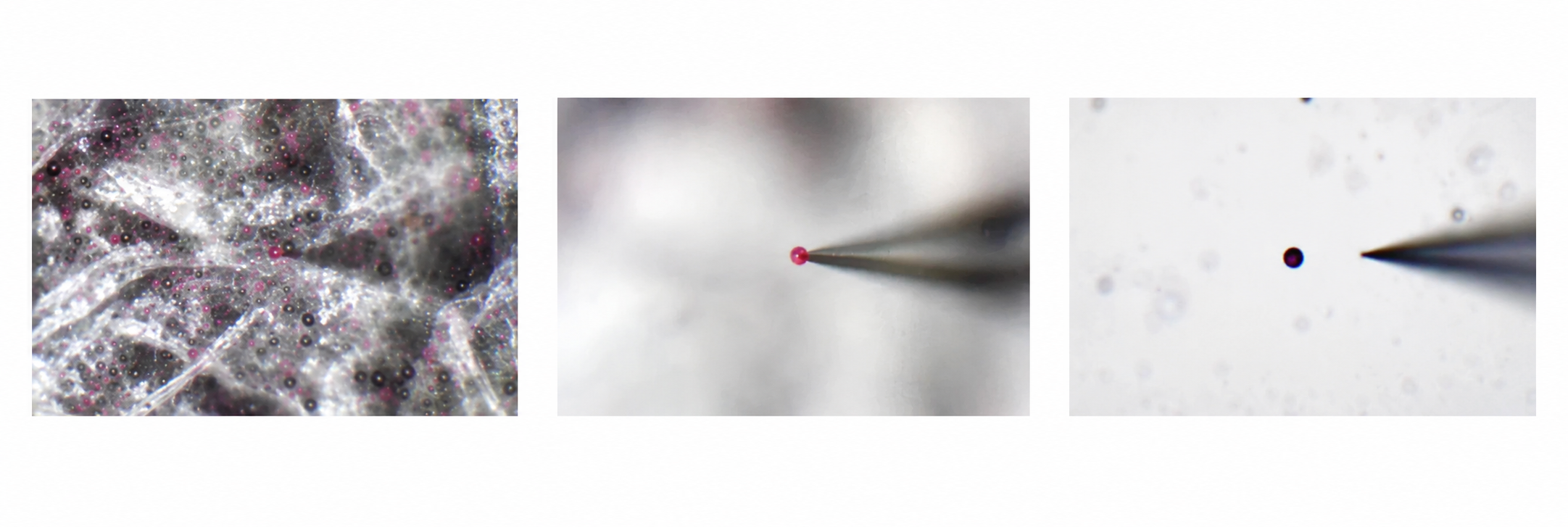
Extracting a Single Particle from a Friction Pen
- Objective: Extract a single red particle from a friction pen sample for further analysis while helping preserve its physical and chemical integrity.
- Significance of This Application: The target particle may be visually similar to surrounding particles; therefore, image analysis is used for identification, dimensional measurement for size verification, and shape observation for differentiation from nearby fragments or contaminants.Extraction begins only after these steps.
- Target Identification and Selection: Friction pen samples can contain multiple particles and material components, making the isolation of a specific target particle a challenging task. The workflow begins with image analysis and selection, using microscopic imaging to identify candidate particles within the field of view.
- To support selection accuracy, operators use:
- Dimensional measurement to verify particle size
- Shape observation to distinguish the target particle from neighboring fragments or contaminants
- High-magnification imaging to document the selected particle before extraction
- This combination of visual and dimensional data helps improve selection accuracy and supports the isolation of the intended particle for further analysis
- Tools Used: Tungsten Probe (TP-0005) and AxisPro for precision-controlled particle isolation.
- Precision Extraction Using the AxisPro Micromanipulation System and Tungsten Probe: Once the target particle has been confirmed, extraction is performed using an AxisPro micro-manipulation system equipped with a Tungsten Probe (TP-0005). The AxisPro is a benchtop micro-manipulation system designed to operate alongside microscopic imaging to enable precise, controlled tool positioning. When extracting a single ink particle, the operator uses AxisPro to advance a probe tip toward the target under real-time visual feedback.
Key system capabilities include:
- Motorized micro-positioning under continuous microscopic observation
- Precise control of probe approach angle and contact location
- Repeatable movements for stable particle manipulation
The Tungsten probe, available with tip diameters ranging from 0.2 µm to 30 µm, can be matched to the dimensions of the target particle. Fine-tip probes are particularly useful for isolating small ink particles while minimizing disturbance to adjacent material.
Using AxisPro’s controlled positioning, the probe can:
- Contact and isolate the selected particle while minimizing disturbance to adjacent material
- Separate it from the surrounding matrix
- Transfer it to a clean substrate for further examination
- Benefits for Downstream Analysis: This approach supports non-destructive single-particle extraction and helps maintain sample integrity for subsequent analytical techniques such as:
- Raman Microscopy
- FTIR Microscopy
- Scanning Electron Microscopy (SEM)
By combining image-guided selection with precision micromanipulation, the system supports accurate isolation of individual ink particles while helping minimize contamination and improve analytical reliability. The system is also capable of recording images and video of each manipulation, which supports documentation at every step of the workflow.
Video Demonstration: View Demonstration of single-particle ink extraction using precision micromanipulation under microscopic observation.
Vacuum Adsorption of Industrial Diamond Particles
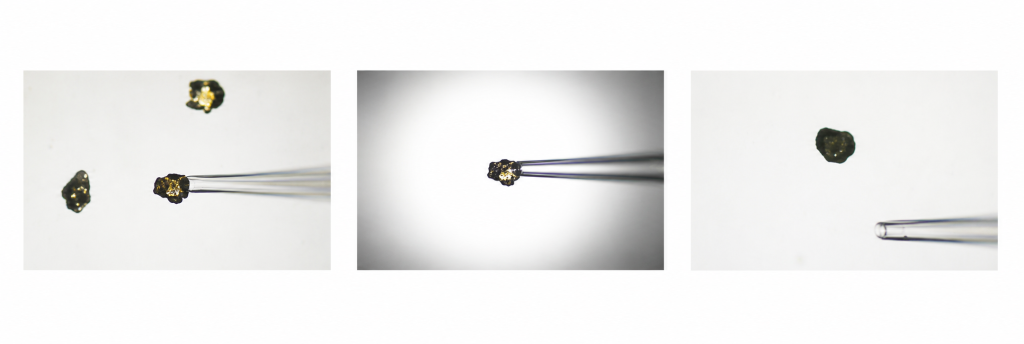
- Objective: Pick up and transfer individual industrial diamond particles (≥100 μm) to a designated location for inspection, measurement, or further processing while maintaining placement accuracy and minimizing particle loss.
- Significance of This Application: Industrial diamond particles are widely used in abrasive tools, cutting applications, and surface finishing processes. In quality control, materials research, and particle sorting applications, individual particles often need to be isolated from a bulk sample and transferred to a specific location for examination, measurement, or placement.
Unlike many smaller particles that can be manipulated using probe-based techniques, diamond particles in the ≥100 μm range may roll or shift during mechanical contact. Their size and geometry often make vacuum-based handling a more effective approach for controlled pickup, transfer, and placement.
- Target Identification and Preparation: The workflow begins with microscopic observation to locate and confirm the target particle within the field of view. Visual inspection helps verify that the correct particle is selected before pickup and transfer.
To support accurate handling, operators use:
- Microscopic imaging to identify the target particle
- Visual confirmation of particle size and position
- Real-time observation during pickup and placement
This imaging-guided approach helps improve selection accuracy and supports transfer of the intended particle.
- Tools Used: Vacuum Adsorption Tool Set and Micro Pipette for controlled suction, pickup, transfer, and release of particles.
- Precision Pickup and Transfer Using Vacuum Adsorption Tool Set and Micro Pipette: Once the target particle has been identified, handling is performed using a Vacuum Adsorption Tool set equipped with a Micro Pipette. The system uses controlled suction to hold a particle during transfer and controlled release to support accurate placement at the desired location.
Under microscopic observation, the operator positions the Micro Pipette above the target particle and applies vacuum suction to achieve pickup. The particle is then transferred and released through controlled adjustment of the vacuum level.
Key system capabilities include:
- Controlled suction for secure particle pickup
- Reduced mechanical contact during transfer
- Visual confirmation of pickup and release under magnification
- Repeatable placement of individual particles
Micro Pipette selection plays an important role in pickup and transfer performance. The pipette aperture can be matched to the particle size to improve pickup reliability while reducing the likelihood of collecting adjacent particles.
Using the Vacuum Adsorption Tool Set and Micro Pipette, operators can:
- Pick up individual particles using controlled suction
- Transfer particles to a specified location with controlled placement accuracy
- Release particles in a controlled and repeatable manner
- Handle particles ≥100 μm without direct mechanical contact
- Benefits for Particle Placement and Material Processing: This approach supports efficient and repeatable handling of industrial particles while reducing the risk of displacement during transfer.
Key benefits include:
- Secure pickup and controlled release of individual particles
- Reduced risk of particle loss during handling
- Improved placement accuracy for inspection and processing workflows
- Efficient transfer of larger micro-scale particles compared to many mechanical manipulation methods
By combining microscopic observation with vacuum-based absorption, the system supports reliable single-particle pickup and transfer for quality control, materials research, and industrial particle handling applications.
Comparing the Two Approaches: Micro-Manipulation vs. Vacuum Adsorption
Both micro-manipulation and vacuum adsorption support precise handling of individual particles, but each is optimized for different particle sizes and workflow requirements.
Micromanipulation: Best suited for applications that require targeted particle selection, isolation, and extraction.
Key advantages:
- Ideal for smaller particles and complex sample matrices
- Supports Image Analysis and Selection before handling
- Supports dimensional measurement and shape observation to verify particle characteristics
- Provides precise, controlled positioning for single-particle extraction
- Well suited for forensic analysis, material characterization, and failure analysis
Vacuum Adsorption: Best suited for efficient pickup and transfer of larger particles, typically ≥100 μm.
Key advantages:
- Uses controlled suction, absorption, and release for reliable particle handling
- Supports non-contact pickup and delivery of particles
- Offers high repeatability for multiple transfer operations
- Helps reduce the risk of particle loss during transfer
- Well suited for industrial particle sorting, quality control, and material placement applications
An Integrated Workflow: From Particle Identification to Analysis-Ready Transfer
Precision particle handling is most effective when selection, extraction, transfer, and analysis are connected within a structured workflow.
1. Particle Identification and Verification
- Use image analysis and selection to locate candidate particles.
- Apply dimensional measurement and shape observation to verify particle size and morphology.
- Confirm the target particle before handling begins to help reduce selection errors.
2. Precision Extraction
- Use the AxisPro micromanipulation system to isolate the selected particle under real-time microscopic observation.
- Perform controlled extraction while minimizing disturbance to surrounding material.
3. Transfer and Placement
- Transfer the particle using a Tungsten Probe, Micro Pipette, or Vacuum Adsorption Tool Set, depending on particle size and application requirements.
- For larger particles (≥100 μm), vacuum-assisted transfer supports reliable pickup and controlled release.
4. Preparation for Analysis
- Position the particle for downstream techniques such as Raman Microscopy, FTIR Microscopy, or SEM.
- Maintaining particle integrity during handling supports reliable analytical results.
The workflow follows a clear progression:
Selection → Extraction → Transfer → Analysis
Each stage supports the next, helping maintain accuracy, repeatability, and sample integrity throughout the process.
The optimal handling method depends on particle size, material characteristics, application requirements, and the level of control needed during selection, extraction, and transfer.
Benefits of Advanced Micro-Particle Handling Techniques
Dedicated micromanipulation and vacuum adsorption systems offer several advantages for particle selection, extraction, and transfer compared to conventional manual handling methods.
- Improved Targeting Accuracy
- Combines image analysis, dimensional measurement, and shape observation to support accurate particle selection.
- Helps reduce the likelihood of selecting or extracting the wrong particle.
- Reduced Risk of Contamination
- Controlled extraction and transfer help minimize interaction with adjacent particles and substrate material.
- Supports cleaner sample preparation for downstream analysis.
- Non-Destructive Handling
- Helps maintain the physical and chemical integrity of particles during extraction and transfer.
Helps maintain the reliability of spectroscopic and structural analysis results.
- Helps maintain the physical and chemical integrity of particles during extraction and transfer.
- Enhanced Repeatability
- Motorized micromanipulation and vacuum-based handling support consistent and controlled particle movement..
- Helps reduce variability associated with manual handling methods.
- Greater Efficiency
- Streamlines particle selection, extraction, and transfer workflows.
- Helps reduce sample loss and supports higher-throughput analytical and quality control workflows.
Applications and Use Cases Across Industries
Precision micro-particle handling techniques support a wide range of research, analytical, and industrial applications that require accurate particle selection, extraction, and transfer.
- Electronics and Semiconductors: Applications include contamination analysis on wafers and device surfaces, failure investigation and root-cause analysis of yield-related defects, and identification and characterization of individual contaminant particles.
- Battery Manufacturing: Applications include analysis of electrode and active material particles, evaluation of particle morphology, coating uniformity, and degradation products as well as support for quality control and performance studies.
- Forensics: Applications include extraction of trace evidence such as ink particles, fibers, and pigment fragments, along with chemical and structural analysis of individual particles. Controlled handling can also help reduce the risk of cross-contamination during sample preparation.
- Materials Science: Applications include composition analysis and phase identification, characterization of ceramic, metal, abrasive, and polymer particles, and investigation of particle size, morphology, and material properties.
- Medical and Pharmaceutical Research: Applications include analysis of drug particles and excipient materials, identification of foreign particulate contaminants, and controlled sample preparation for microscopic and spectroscopic analysis.
- Quality Control and Research Laboratories: Applications include single-particle isolation for detailed material characterization, sample preparation for Raman microscopy, FTIR microscopy, SEM, and other analytical techniques, as well as repeatable particle handling for research and inspection workflows.
Optimize Your Micro-Particle Handling Workflow with the Right Instrumentation
If your application involves particle characterization, contamination analysis, failure investigation, materials research, or related analytical workflows, Barnett Technical Services can help you develop an efficient micro-particle handling strategy. We offer integrated solutions that support particle identification, extraction, transfer, and analysis. These include AxisPro micromanipulation systems for precision particle isolation and extraction, as well as Vacuum Adsorption Tool Sets and Micro Pipettes for controlled pickup, transfer, and release of particles ≥100 μm. Explore our range of micromanipulation, vacuum transfer, and analytical solutions, or contact our team to discuss your application requirements and workflow objectives.