
Soil Flux Analysis with ABB LGR-ICOS Laser Gas Analyzers

Accurate measurement of greenhouse gas exchange between soils and the atmosphere represents one of the most challenging aspects of terrestrial carbon cycle research. Traditional soil flux measurement methods often struggled with sensitivity limitations, cross-interference from water vapor, and inability to capture rapid temporal variations in emission patterns. Modern laser-based gas analysers have transformed this field, delivering the precision and real-time measurement capability required for demanding applications from agricultural emission studies to permafrost research.
ABB’s LGR-ICOS technology brings laboratory-grade sensitivity to field-deployable instruments, enabling researchers to quantify soil-atmosphere gas exchange with unprecedented accuracy and temporal resolution.
What Is Soil Flux Analysis?
Soil flux analysis measures the rate at which greenhouse gases move between soil and atmosphere. This exchange involves carbon dioxide (CO₂) from soil respiration, methane (CH₄) from anaerobic decomposition, and nitrous oxide (N₂O) from nitrogen cycling processes. Unlike atmospheric monitoring that tracks ambient concentrations, flux analysis quantifies the actual mass transfer rate, typically expressed in units such as micrograms per square meter per hour.
The measurement process typically employs chamber-based methods where a temporary enclosure placed on the soil surface captures gases as they emerge. By monitoring concentration changes over time within this known volume, researchers calculate emission or uptake rates. The quality of flux measurements depends critically on the gas analyser’s sensitivity, response time, and freedom from measurement artifacts.
Why Soil Flux Measurements Matter
Soils exchange enormous quantities of greenhouse gases with the atmosphere. These fluxes vary dramatically across ecosystems, seasons, and management practices. Agricultural soils can shift from net carbon sinks to significant emission sources depending on tillage, fertilization, and irrigation practices. Wetlands alternate between methane production and consumption based on water table depth. Permafrost regions release stored carbon as warming accelerates microbial decomposition.
Quantifying these processes requires measurement systems capable of detecting subtle concentration changes against variable background levels while operating reliably in challenging field conditions. The data supports applications ranging from carbon accounting and offset verification to process-level research into microbial activity and nutrient cycling.
Limitations of Traditional Soil Flux Measurement Methods
Earlier approaches to soil flux measurement presented significant operational challenges.
Gas Chromatography provided high sensitivity but required sample collection, transport to laboratory facilities, and batch analysis. This workflow introduced delays between sampling and results, making it impossible to capture real-time flux dynamics or conduct adaptive sampling strategies. Laboratory analysis also risked sample contamination or degradation during storage and transport.
Non-Dispersive Infrared (NDIR) Sensors offered continuous measurement capability but suffered from cross-sensitivity to water vapor, a critical limitation given that soil chambers often operate at high humidity levels. NDIR instruments also typically lacked the sensitivity required to detect low emission rates or subtle temporal patterns.
Photoacoustic Spectroscopy achieved reasonable sensitivity but required frequent calibration and careful maintenance to sustain accuracy. Field deployment often proved challenging due to sensitivity to vibration and temperature variations.
These limitations constrained what questions researchers could address and which sites they could effectively study.
How LGR-ICOS Technology Works for Soil Flux Measurement
Off-Axis Integrated Cavity Output Spectroscopy (OA-ICOS) represents a fundamental advance in field-deployable gas analysis. The technology uses a tuneable diode laser and an optical cavity to achieve exceptional measurement sensitivity while maintaining robust performance in variable field conditions.
The optical cavity extends the effective measurement path length to thousands of meters within a compact instrument housing. This dramatically increases sensitivity compared to conventional absorption spectroscopy. The off-axis injection design reduces sensitivity to optical alignment, improving long-term stability and reducing maintenance requirements compared to earlier cavity-enhanced methods.
For soil flux applications, OA-ICOS delivers several critical advantages. The technology achieves parts-per-billion sensitivity for target gases, enabling detection of low emission rates from ecosystems with minimal background flux. Measurement rates up to 1 Hz capture rapid concentration changes during chamber closure, improving flux calculation accuracy. Perhaps most importantly, the molecular-level selectivity of laser spectroscopy virtually eliminates cross-interference from water vapor, maintaining measurement accuracy even in high-humidity chamber environments.
LGR-ICOS Analyzers for Soil Flux Research
ABB manufactures several analyser configurations optimized for terrestrial flux measurement applications.
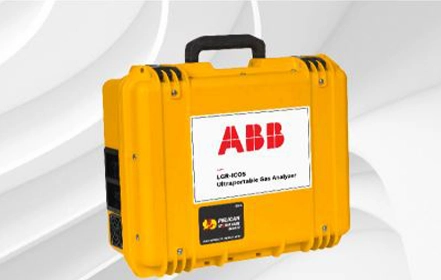
The LGR-ICOS™ GLA131-GGA provides simultaneous measurement of methane (CH₄) and carbon dioxide (CO₂), the primary gases exchanged in most terrestrial ecosystems. Weighing less than 6 kg, this micro portable analyser supports single-person deployment to remote field sites. Battery operation enables measurements at locations without electrical infrastructure. Fast response time captures transient emission events such as methane pulses following precipitation or CO₂ bursts after soil disturbance.
For comprehensive flux studies requiring water vapor data, the LGR-ICOS™ GLA132-GGA simultaneously measures CH₄, CO₂, and H₂O. Water vapor measurements enable correction algorithms that account for dilution effects and support analysis of coupled carbon and water cycling. The ruggedized design withstands demanding field conditions from tropical rainforests to arctic tundra environments.
The LGR-ICOS™ GLA151-N2OCM addresses the specialized requirements of nitrous oxide research. This analyser measures N₂O concentrations and isotopic ratios (δ¹⁵N and δ¹⁸O), enabling source attribution that distinguishes between natural microbial processes and anthropogenic nitrogen inputs from fertilizer application. This isotopic information proves particularly valuable in agricultural systems where management practices strongly influence emission patterns.
All LGR-ICOS platforms share core technological advantages: minimal calibration drift reducing field maintenance requirements, extensive dynamic range accommodating both background atmospheric concentrations and elevated chamber levels, and resistance to environmental factors that compromise traditional sensors.
Soil Flux Measurement Applications
Agricultural Systems
Cropland and pasture soils represent significant and highly variable greenhouse gas sources. Fertilizer application, tillage operations, and irrigation management all influence emission rates. LGR-ICOS analysers enable researchers to quantify these management effects, supporting development of low-emission agricultural practices and verification of carbon farming initiatives. The GLA151-N2OCM’s isotopic measurement capability proves particularly valuable for distinguishing fertilizer-derived N₂O from natural soil emissions.
Wetland Ecosystems
Wetlands function as major methane sources under anaerobic conditions but can shift to methane consumption when water tables drop. Capturing this dynamic behaviour requires measurement systems with fast response times and high methane sensitivity. Portable LGR-ICOS analysers support transect studies across wetland complexes, revealing spatial patterns in emission hotspots and their relationship to hydrological conditions.
Permafrost and Tundra Environments
Warming arctic and alpine regions release previously frozen carbon as permafrost thaws and microbial decomposition accelerates. These remote environments demand truly portable measurement systems capable of reliable operation in extreme conditions. The GLA131-GGA’s low weight and battery operation enable measurements at sites accessible only by foot or helicopter, while its temperature-stable performance maintains accuracy across arctic temperature ranges.
Forest and Grassland Carbon Cycling
Understanding ecosystem carbon balance requires quantifying both photosynthetic uptake and respiratory losses. Soil respiration measurements with LGR-ICOS analysers provide the critical component for calculating net ecosystem exchange. High-frequency measurements reveal how respiration responds to environmental drivers such as soil moisture and temperature, improving process understanding and model parameterization.
Implementing Effective Soil Flux Measurement Programs
Successful flux measurement programs combine appropriate instrumentation with rigorous field protocols.
Chamber design significantly influences measurement quality. Chambers must minimize pressure artifacts during deployment while providing adequate mixing to ensure representative sampling. Automated chamber systems enable high-frequency measurements across multiple locations but require careful attention to seal integrity and timing protocols. Manual chambers offer greater deployment flexibility but introduce potential operator effects on measurement timing and chamber placement.
Data analysis workflows must account for the non-linear concentration buildup that occurs in soil chambers, particularly during the initial moments after closure. Linear regression approaches may introduce systematic bias in flux calculations. More sophisticated analysis methods that account for chamber leakage, gas diffusion dynamics, and non-steady-state conditions improve accuracy but require higher-quality concentration time series, a strength of fast-response LGR-ICOS analysers.
Quality assurance procedures should include periodic verification with reference gas standards, particularly for long-term monitoring programs. Environmental parameter logging (temperature, pressure, humidity, chamber headspace volume) supports proper flux calculations and aids interpretation of observed patterns. Documentation of site conditions, vegetation characteristics, and soil properties enables comparison across studies and integration into broader synthesis efforts.
Advantages of LGR-ICOS Over Alternative Technologies
Compared to gas chromatography, LGR-ICOS analysers provide continuous real-time measurements that eliminate sample handling artifacts and enable adaptive sampling strategies. Field researchers can observe flux patterns as they develop, adjusting measurement protocols to capture unexpected events or optimize sampling intensity.
Relative to NDIR sensors, the molecular selectivity of laser spectroscopy maintains accuracy in high-humidity chamber environments where traditional infrared absorption methods experience cross-interference. This proves particularly critical for agricultural and wetland applications where chamber humidity often approaches saturation.
The long-term stability of OA-ICOS technology reduces calibration frequency compared to photoacoustic or electrochemical sensors. Extended field campaigns become logistically simpler when calibration requirements decrease from daily or weekly to monthly intervals or longer.
Field Performance and Reliability
LGR-ICOS analysers have demonstrated robust performance across diverse research environments. Deployments range from intensive agricultural experiments in California’s Central Valley to permafrost monitoring stations on Alaska’s North Slope. The technology operates effectively across wide temperature ranges, maintaining specified performance from sub-zero arctic conditions to hot arid environments.
The rugged construction withstands transportation to remote field sites and operates reliably despite dust, precipitation, and temperature cycling. Battery operation enables measurements at locations dozens of kilometres from electrical infrastructure, expanding the geographic scope of flux research into previously inaccessible ecosystems.
Standards and Measurement Confidence
Reliable soil flux analysis requires instruments that deliver consistent, traceable measurements across diverse field conditions. LGR-ICOS technology provides the sensitivity, selectivity, and stability that demanding research applications require while maintaining the portability and ruggedness essential for field deployment.
Barnett Technical Services takes immense pride in being an Authorized Distributor of ABB-LGR instruments, supporting researchers with proven soil flux analyser solutions, application knowledge, and comprehensive technical support. With the right instrumentation and expertise, environmental scientists can confidently address today’s critical questions about terrestrial greenhouse gas cycling.
LGR-ICOS Analyzers for Soil Flux Applications
| Analyzer Model | Target Gases | Key Applications |
| LGR-ICOS™ GLA131-GGA | CH₄, CO₂ | Soil respiration, wetland emissions, permafrost monitoring |
| LGR-ICOS™ GLA132-GGA | CH₄, CO₂, H₂O | Multi-gas flux studies, water-carbon coupling, ecosystem monitoring |
| LGR-ICOS™ GLA151-N2OCM | N₂O, δ¹⁵N, δ¹⁸O | Agricultural emissions, fertilizer studies, isotopic source attribution |