
Raman Spectroscopy in the Analysis of Food
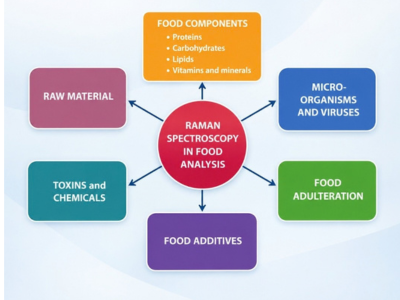
The verification of purity and quality of food products has become an increasingly critical focus for modern food science and regulatory industries. As standards and expectations from consumers and regulators continue to rise, methods to verify the composition of food products must be rapid, reproducible, and non-destructive. One technique showing considerable potential is Confocal Raman Microscopy, which has emerged as a significant tool in food analysis for purity, safety, and compositional assessment.
This technique combines the power of Raman spectroscopy with high-resolution imaging to obtain chemical information about food materials without altering the sample in any way. The capabilities of this technique can be utilized to evaluate food materials from both an ingredient verification perspective and a contaminant identification approach, making it highly applicable to food companies, food industry inspection, and food development research.
Understanding Confocal Raman Microscopy for Food Analysis
Confocal Raman microscopy enables the analysis of chemical compounds within microscopic spaces. Through the inelastic scattering of laser light (the Raman effect), confocal Raman microscopy provides a molecular fingerprint of materials that can be used to identify molecular compositions, quantify ingredients, and assess food structure at the microscale level. Most importantly, all of this can be accomplished without sample preparation or damaging sample processing.
The confocal design allows spatial filtering, which facilitates clear three-dimensional visualization of samples. This capability is especially beneficial when dealing with heterogeneous food products such as dairy, meat, oils, grains, and processed foods, where different ingredients or contaminants can be layered or embedded together.
Key Applications in Food Quality Assessment
Ingredient Authentication and Verification
Food fraud and mislabelling remain serious concerns worldwide. When compared with verified reference standards, Raman spectroscopy can validate the authenticity of ingredients by comparing their molecular signatures with established databases. For example, Raman can differentiate between authentic high-quality saffron and counterfeit alternatives made from less expensive fillers, or detect dilution in high-value oils with lower-grade substitutes.
Adulteration and Contaminant Detection
Whether detecting melamine in milk or synthetic dyes in spices, Confocal Raman Microscopy can quickly identify adulterant substances that are traditionally difficult to detect with conventional methods. This capability allows manufacturers to ensure product safety and meet regulatory requirements with confidence.
Food Matrix Structure Analysis
Understanding how food components such as proteins, fats, and carbohydrates are distributed throughout a product can help food manufacturers optimize texture, extend shelf-life, and enhance taste. Raman imaging enables assessment of food matrix structures at the microscale level, such as fat distribution in chocolate or sugar crystallization patterns in confections.
Microplastic and Foreign Particle Identification
Growing concerns about microplastic particles in food products and material migration from packaging are driving demand for sensitive detection methods. Confocal Raman systems can analyze quantifiably small particles in food products and packaging materials without destruction, while also classifying unknown particles and identifying their chemical structures.
Shelf-Life and Spoilage Monitoring
Food degradation processes such as oxidation and fermentation cause changes in molecular structures that can be detected using Raman spectroscopy. This enables manufacturers to assess shelf-life, evaluate freshness, and determine optimal storage and packaging conditions based on real-time molecular changes.
Advantages of Confocal Raman Microscopy in Food Science
- Non-destructive testing: Samples can be analyzed without damage, preserving valuable or limited supplies for additional testing
- Label-free analysis: No dyes or reagents are required; analysis is based purely on intrinsic molecular signals
- Superior spatial resolution: Provides molecular structure information at microscopicdimensions
- Rapid and reproducible: Delivers real-time analysis with consistent results between batches
- Versatile sample compatibility: Works effectively with solids, powders, liquids, emulsions, and gels
These advantages enhance capabilities for both laboratory-based food R&D and manufacturing quality-control environments.
Barnett Technical Services: Your Partner in Precision Food Analysis
Barnett Technical Services offers state-of-the-art Confocal Raman Microscopes designed to meet the evolving needs of food scientists. Whether you require detailed ingredient verification, contaminant detection, or structural imaging, we provide proven tools backed by expert consultation and comprehensive training support.
Recommended Systems for Food Analysis
Confotec® NR500 A high-performance, fully automated confocal Raman microscope with exceptional versatility for analyzing multi-layer food items. This system can generate detailed chemical maps to track ingredient distribution while detecting micro-level defects or adulterants with up to 5 laser configurations available.
Confotec® Duo A compact dual-laser system (532 nm and 785 nm) that combines effective imaging with superior Raman detection. This system offers the flexibility to analyze complex food matrices including emulsions, dairy products, and mixed powders with enhanced spatial resolution.
Confotec® MR Series (MR200, MR350, MR520, MR750) Purpose-built systems for applications requiring high-resolution chemical imaging. The cost-effective Confotec® MR200 is particularly suitable for routine food quality applications requiring precision imaging, while the higher-end models offer advanced capabilities for specialized research applications.
Confotec® CARS System The most advanced Raman solution for ultra-sensitive imaging applications. This multifunctional system combines CARS, Raman/luminescent, and conventional confocal microscopy to deliver ultra-fast detection of weak signals that might be overlooked by traditional Raman systems in food samples.
Confotec® Uno A compact, cost-effective solution featuring a single built-in laser (532 nm or 785 nm) with a 4096-pixel linear CCD detector. This system provides high-resolution spectra and efficient light collection, making it ideal for routine food analysis applications.
All systems are backed by Barnett’s experienced technical team, who provide comprehensive support including setup, training, application development, and ongoing service.
Product Line: