
Isolation of Foreign Materials for Failure Analysis
In failure analysis and quality control, identifying the root cause of a defect often comes down to isolating a microscopic particle on or buried beneath a surface, adhered to a sensitive substrate, or embedded within a multilayer film. The challenge is not simply locating it. It is extracting it, without contaminating it with surrounding material, and ideally without damaging the base component in the process.
Conventional approaches such as manual tweezers, adhesive tape lifts, or bulk scraping lack the positional control needed to isolate particles at the microscale selectively. They introduce cross-contamination from surrounding material, risk destroying the region of interest, or produce samples too mixed with substrate material to yield clean analytical data. When the particle of interest is a foreign substance on a PCB terminal, a defect buried beneath a polymer film surface, or a microscopic contaminant adhered to a glass or painted surface, a more controlled approach is required.
The MicroSupport Axis Pro micromanipulator, available from Barnett Technical Services, addresses these challenges directly. By mounting specialized micro-tools including the Ruby Knife and Micro Peeler variants of MicroSupport’s Micro-knife and Tungsten Carbide tool families, onto the Axis Pro’s motorized arms and operating under an integrated zoom microscope visualization, analysts can perform three distinct micro-sampling operations: surface scraping to expose buried targets, selective foreign substance capture from sensitive substrates, and controlled peeling to isolate surface-adhered microscopic materials. All three are demonstrated in the application examples below.
Equipment
The MicroSupport Axis Pro micromanipulator serves as the platform for all three operations. The system includes an integrated zoom microscope, a motorized XYZ stage, and two motorized arms, all controlled via PC mouse with a minimum step size of 0.1 µm. The arms accept a range of interchangeable micro-tools, allowing a single instrument to cover multiple sampling geometries without reconfiguration of the core system.
The Ruby Knife is a variant of MicroSupport’s Micro-knife family with a blade made from ruby, available in flat-edge geometry. It is one of the best tools when the target is buried beneath a surface layer and must be progressively exposed by controlled material removal.
The Micro Peeler is a variant of MicroSupport’s Tungsten Carbide tool family, with a sculpting knife-like tip geometry. It is designed for flat-surface cutting of polymers and high-barrier films, selective removal of surface-adhered foreign particles, elimination of micro-protrusions, and pinpoint cutting of fine conductive structures such as IC bonding wires. It is the correct tool when the target is at or near the surface and must be separated from the substrate without penetrating or damaging the base material beneath.
The Micro Peeler tip can also be used with MicroSupport’s Milling Pro accessory – this accessory introduces a hypersonic vibration into the tungsten carbide tip, allowing for a smooth scraping of many materials.
These tool families are selected based on sample geometry and the sample material. Using the wrong tool for the geometry risks either missing the target or damaging the base material.
Downstream characterization of extracted samples is typically performed by FT-IR microscopy, Raman microscope, or SEM-EDS. For related microsampling services, Barnett Technical Services can support sample preparation workflows directly.
Application 1: Exposing Embedded Targets in Film
Sample: Film | Tool: Ruby Knife | Operation: Scraping off surface to expose target substances
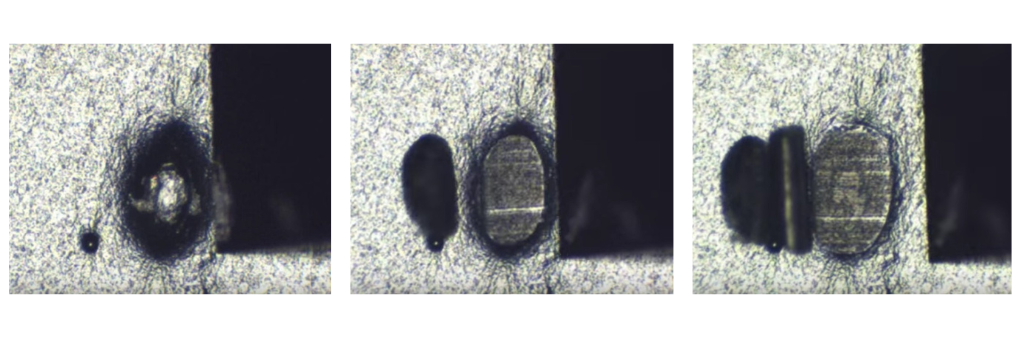
Figure 1: Sequential microscope images: Ruby Knife scraping the film surface progressively to expose the buried target substance
Image Credit: https://www.microsupport.co.jp
When a target substance a defect, contaminant, or structural feature is buried beneath the surface of a film or coated material, it must first be exposed before it can be sampled or analyzed. Cutting through the film risks displacing or contaminating the target. What is needed is controlled, progressive surface removal that stops precisely at the target depth.
The Ruby Knife, mounted on the Axis Pro arm, is advanced across the film surface at a controlled angle under zoom microscope observation. The ruby flat-edge geometry enables inclined cutting progressively shaving the surface layer to expose what lies beneath — while ruby’s optical properties minimize shadowing at the cutting edge, improving visualization of the emerging target area. The Axis Pro’s 0.1 µm step control allows the operator to advance the knife incrementally, stopping as soon as the target is exposed rather than overshooting into it.
The result is a cleanly exposed target surface, accessible for direct in situ analysis by FT-IR microscopy or SEM, or for subsequent physical extraction by a second micro-tool operation. The base film around the exposed area remains intact and undisturbed.
Application 2: Selective Foreign Particle Capture from PCB Terminal Surfaces
Sample: Terminal of printed circuit board | Tool: Micro Peeler | Operation: Capture foreign particles from the surface of an electrical pad
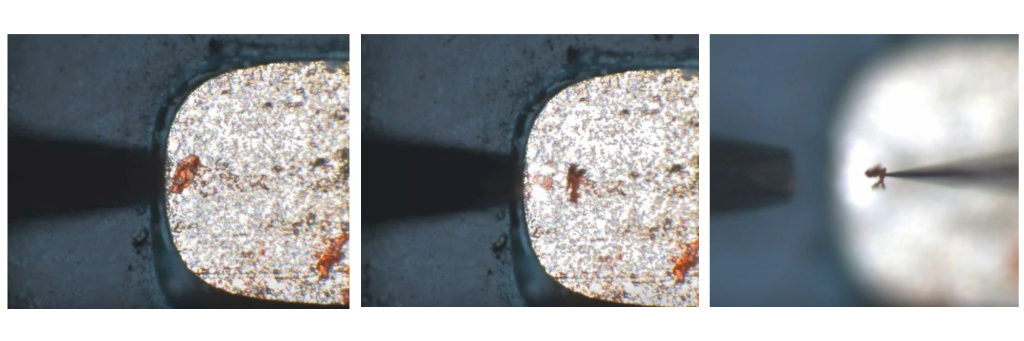
Image Credit: https://www.microsupport.co.jp
Foreign particles on electrical contact pads solder contamination, metallic debris, polymer residues can cause contact failures, intermittent faults, or interfere with downstream processing. Identifying the particle’s composition requires extracting it intact for FT-IR or SEM-EDS analysis, without disturbing the pad surface or mixing substrate material into the sample.
The Micro Peeler’s sculpting knife-like tip is positioned under zoom microscope visualization to approach the foreign particle laterally at pad surface level. The tool shaves or scrapes only the adhered particle, separating it from the pad without cutting into the copper or solder structure underneath. Because the Axis Pro provides precise XYZ control of the approach angle and contact motion, the operator can work selectively around the particle boundary, capturing only the foreign material.
This selective extraction preserves the base pad for continued function or further electrical inspection while delivering an isolated particle sample with minimal substrate contamination a direct benefit for FT-IR spectral identification, where substrate signal overlap can obscure the target spectrum.
Application 3 : Peeling and Capturing Surface-Adhered Microscopic Substances
Sample: Surface-adhered material on glass, paint, polymer, or electronic substrate | Tool: Micro Peeler | Operation: Peel and capture microscopic surface deposits
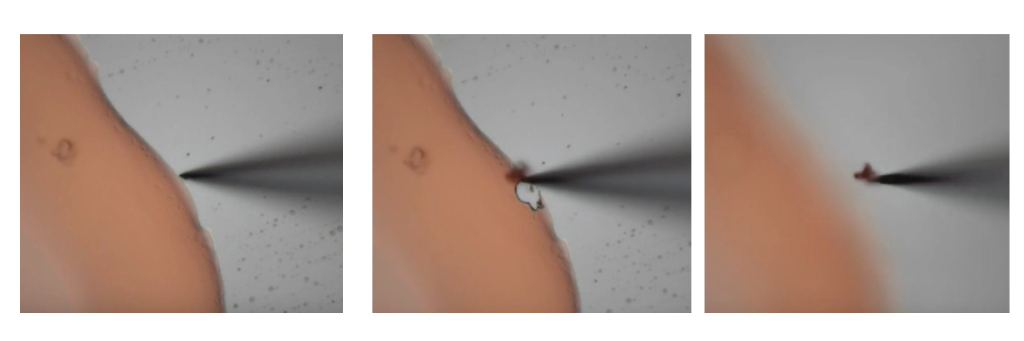
Image Credit: https://www.microsupport.co.jp
Some foreign substances are not embedded but are adhered to a surface thin film of contamination, microscopic paint fragments, surface deposits, or reaction byproducts. These require a peeling rather than a digging action: lifting the adhered material away from the substrate surface cleanly without smearing it or fragmenting it.
The Micro Peeler’s flat sculpting tip is engaged at the edge of the adhered substance and advanced beneath it, using the Axis Pro’s controlled motion to progressively peel the material from the substrate. The zoom microscope provides continuous visual feedback, allowing the operator to adjust tool angle and advance rate in real time based on how the material is releasing from the surface. The peeled material can be transferred directly to an FT-IR or SEM sample holder for analysis.
This approach is applicable across a wide range of substrate types including glass, polymer films, painted surfaces, and electronic components wherever surface-adhered foreign material must be captured without introducing substrate contamination into the analytical sample.
Key Observations
Tool selection is determined by sample geometry and sample material. The Ruby Knife is the correct choice when the target is buried beneath a surface and progressive exposure is required by controlled material removal. The Micro Peeler is correct when the target is at or near the surface and must be separated from the substrate selectively. Selecting the wrong tool for the geometry risks either missing the target or damaging the base material — neither outcome is acceptable in failure analysis work where the sample may be unique.
Zoom microscope visualization is what makes selective extraction possible. The Axis Pro’s integrated zoom microscope allows the operator to observe tool contact and material response in real time and adjust approach dynamically. Without this continuous visual feedback, controlled micro-scale separation cannot be achieved reliably or reproducibly.
Base material integrity is preserved across all three operations. Each procedure is designed to isolate the target while leaving the underlying substrate undamaged and available for continued inspection, electrical testing, or further processing a significant advantage over bulk sampling methods that destroy the component to access the particle.
Extracted samples are analytically clean. Because the extraction is geometrically selective rather than bulk, isolated material contains minimal substrate contamination. This directly improves the quality of FT-IR or Raman spectral identification and SEM-EDS compositional analysis, where substrate signal interference is a persistent challenge with conventionally prepared samples.
The same platform supports all three operations through tool interchange. Swapping tools on the Axis Pro arms is a rapid operation. A single instrument covers the full range from progressive surface exposure to selective particle capture to peeling, without requiring separate dedicated instruments for each sample geometry encountered in a typical failure analysis workflow.
Conclusions
The MicroSupport Axis Pro micromanipulator, combined with the Ruby Knife and Micro Peeler tool variants, provides a practical and reliable platform for three distinct micro-sampling challenges encountered routinely in failure analysis, contamination investigation, and quality control: exposing embedded targets in films, selectively capturing foreign particles from sensitive substrates such as PCB terminals, and peeling surface-adhered microscopic substances for clean analytical extraction.
By operating under continuous zoom microscope visualization with motorized 0.1 µm positional control, analysts can perform these operations with a level of selectivity and reproducibility that manual methods cannot approach delivering analytically clean isolated samples ready for SEM or FT-IR characterization while leaving the base component intact and available for further use.
Barnett Technical Services provides the Axis Pro micromanipulator, the complete range of MicroSupport micro-tools including the Ruby Knife and Micro Peeler, and microsampling services for failure analysis, contamination investigation, and sample preparation workflows across electronics, materials science, pharmaceutical, and forensic science applications.
Steve’s Solutions
This Steve’s Solution demonstrates selective micro-sampling of surface contaminants and embedded particles using the Micro Support Axis Pro micromanipulator. To explore related workflows, see Particle and Defect Isolation with a Bench Top Micromanipulator and Micro Support Micromanipulator for Separation of Paint Layers in Trace Analysis.
For more information, please contact us.
To view more solutions, visit the Steve’s Solutions page.
Related Products