
Testing Specific Heat Capacity of Cylindrical, Button, and Pouch Batteries using Hot Cell® Sensors
Background
The rapid expansion of rechargeable battery technology in electric vehicles, portable electronics, and energy storage systems has made thermal management a critical factor in battery performance, safety, and longevity. Accurate measurement of specific heat capacity (Cp) is essential for thermal modeling and battery management system design as it determines how batteries respond to temperature changes during operation.
Conventional methods such as Differential Scanning Calorimetry (DSC) are limited to testing small sample volumes and require destructive sampling of battery components. These approaches cannot capture the thermal behavior of complete battery assemblies, which include casings, electrodes, electrolytes, and separators in their integrated configuration. This creates a significant gap in battery characterization as measurements of isolated components fail to represent the thermal properties of real-world battery systems.
Objective
The objective of this work was to develop and validate a non-destructive method for directly measuring the specific heat capacity of complete battery cells across multiple commercial formats. By utilizing the innovative Hot Cell® sensors integrated with the Hot Disk® Transient Plane Source (TPS) thermal analysis system, this approach enables testing of batteries in their as-manufactured state without disassembly or material extraction.
The method was designed to accommodate all major battery geometries currently used in commercial applications, including cylindrical cells (e.g., 18650, 21700 formats), button cells, and pouch cells. This capability addresses a critical gap in battery characterization by providing accurate and representative Cp values for real-world battery configurations, enabling more precise thermal modeling and improved battery management system design.
Battery Samples
Six lithium battery samples of varying size and type were selected to represent the range of formats commonly used in consumer electronics, electric vehicles, and energy storage systems. The sample set included:
- Two cylindrical cells in industry-standard sizes (18650, 21700)
- Two button cells representing small-format applications
- Two pouch cells used in mobile devices and electric vehicles
Two samples from each category were tested to validate measurement reproducibility and establish confidence in the methodology. All samples represented complete commercial battery structures with intact casings, terminals, and internal components in their as-manufactured state.
Experimental Setup
Specific heat capacity measurements were performed using a Hot Disk® TPS 2500 S thermal constants analyzer equipped with specialized Hot Cell® sensors. The Hot Cell® design consists of an aluminum cell with lid and a TPS heating element attached to the base. The measurement principle relies on transient temperature response analysis, comparing thermal behavior with and without the sample present.
The sensor geometry was adapted based on battery format: a tall cylindrical cell for standard cylindrical batteries, a flat cylindrical cell for button cells, and a flat box with rounded edges for pouch batteries.
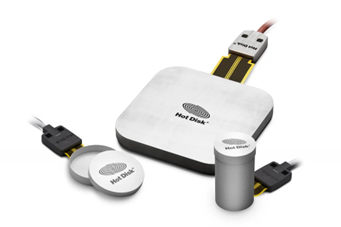
Image Credit: https://www.hotdiskinstruments.com/products/#hot-cell-sensors
For each battery type, the measurement procedure consisted of two sequential runs:
- Reference measurement: Performed with the empty Hot Cell® to establish the baseline thermal response of the sensor in isolation.
- Sample measurement: Performed with the battery embedded in insulating foam within the cell.
The battery sample was positioned to ensure thermal contact with the base of the cell, where the TPS element provides controlled heating. High-density insulating foam surrounded the battery to minimize heat loss to the environment and ensure that thermal energy transfer occurred primarily through the sample. For cylindrical batteries with air gaps, a thin layer of thermally conductive silicone oil was applied to enhance thermal contact between the battery casing and the cell walls.
The specific heat capacity was calculated from the difference between the two transient temperature recordings using the Hot Disk analytical software, which accounts for the thermal properties of the cell materials and the measurement geometry.
Results and Validation
Method validation was performed using reference materials with known specific heat capacity values. Stainless steel samples were measured using both the Hot Cell® configuration and the standard Hot Disk® two-sensor method. The comparison demonstrated excellent agreement, with observed deviations of less than 3.7% on average, confirming the accuracy and reliability of the Hot Cell® approach for complex sample geometries.
| Sample | Cell Type | Measured Time (s) | Measured Power (W) | Specific Heat Capacity (J/kg/K) |
| 1 | Cylindrical cell | 640 | 0.45 (0.3) | 870 |
| 2 | Cylindrical cell | 2560 | 0.48 (0.3) | 862 |
| 3 | Button cell | 80 | 0.5 (0.25) | 785 |
| 4 | Button cell | 80 | 2.0 (1.8) | 734 |
| 5 | Pouch cell | 160 | 2.8 (2.2) | 820 |
| 6 | Pouch cell | 640 | 6.5 (5.0) | 892 |
Measurement results of Cp tests on lithium batteries using Hot Cell® sensors, reported in J/kg/K.
Specific heat capacity measurements were successfully obtained for all six battery samples tested. The obtained Cp values, reported in J/kg/K, were well-aligned with available data in the literature for similar battery chemistries and configurations. The Hot Cell® method provided more representative values by measuring complete battery systems rather than extrapolating from individual component measurements.
Key Observations
- Non-destructive testing of complex structures: The Hot Cell® method enables measurement of complete battery assemblies without requiring disassembly or component separation, preserving the integrated thermal behavior that cannot be captured through testing of isolated materials.
- Scalable sensor design for all battery sizes: The adaptable Hot Cell® configuration accommodates battery formats ranging from small button cells to large-format prismatic and pouch cells used in electric vehicles, making the method applicable across consumer electronics, automotive, and grid storage applications.
- Enhanced thermal contact for cylindrical batteries: Optimal measurement accuracy for cylindrical battery formats was achieved by applying a thin layer of thermally conductive silicone oil between the battery casing and cell walls, eliminating air gaps and ensuring efficient heat transfer.
- Superior representation of real-world thermal behavior: By measuring batteries in their as-manufactured state, the Hot Cell® approach provides more representative Cp values compared to traditional methods that extrapolate from individual component measurements, capturing the actual thermal response of complete systems.
Conclusion
In this study, the feasibility of using Hot Cell® sensors to measure the specific heat capacity of complete battery assemblies was demonstrated across multiple commercial battery formats. By adapting the Hot Disk Transient Plane Source method with specialized Hot Cell® configurations, it was possible to directly measure Cp values for cylindrical, button, and pouch batteries in their as-manufactured state without requiring destructive sampling or component disassembly. The results confirmed that the Hot Cell® method delivers accurate, reproducible, and representative thermal characterization suitable for battery manufacturers and R&D applications.
Steve’s Solutions
This Steve’s Solution demonstrates the application of Hot Cell® sensor technology for advanced battery thermal analysis. Barnett Technical Services offers specific heat capacity testing services, Hot Cell® sensors, and the complete Hot Disk® TPS thermal analysis system for EV, energy storage, and electronics industries.
For more information about testing services, instrumentation, or consultation, please contact us.
To view more innovative solutions and applications, visit the Steve’s Solutions page.